

Investors often ask whether TRON deserves a place in a crypto portfolio. This TRON (TRX) investment outlook answers that question with data instead of hype. TRON does not chase meme trends or flashy DeFi launches. It moves dollars, and it moves them in enormous quantities. Stablecoin traffic drives almost every part of the TRX story, from fees to burn rates to institutional interest. That focus creates real strengths, and it also creates real dangers. We will examine the volume, the fees, the recent milestones, and the risks that could hurt holders. Readers who want more market context can explore the research hub at Scope Bitcoin.
What TRON Is and Why Investors Watch TRX
TRON runs as a delegated proof-of-stake blockchain that produces a block every three seconds. The founders launched the network in 2017 and opened the MainNet in 2018. Over time, the chain found its niche in stablecoin payments rather than gaming or NFTs. Traders, remitters, and exchanges all use it to move USDT cheaply. TRX serves as the fuel that powers those transfers. Users stake it, burn it, and spend it to cover network resources. Because every transfer needs resources, network usage creates direct demand for the token. Investors therefore treat TRX as a bet on payment activity, not on speculation. That distinction shapes every argument in this outlook. The token rises or falls with the health of the stablecoin rail it supports.
How Stablecoin Volume Drives TRX Demand
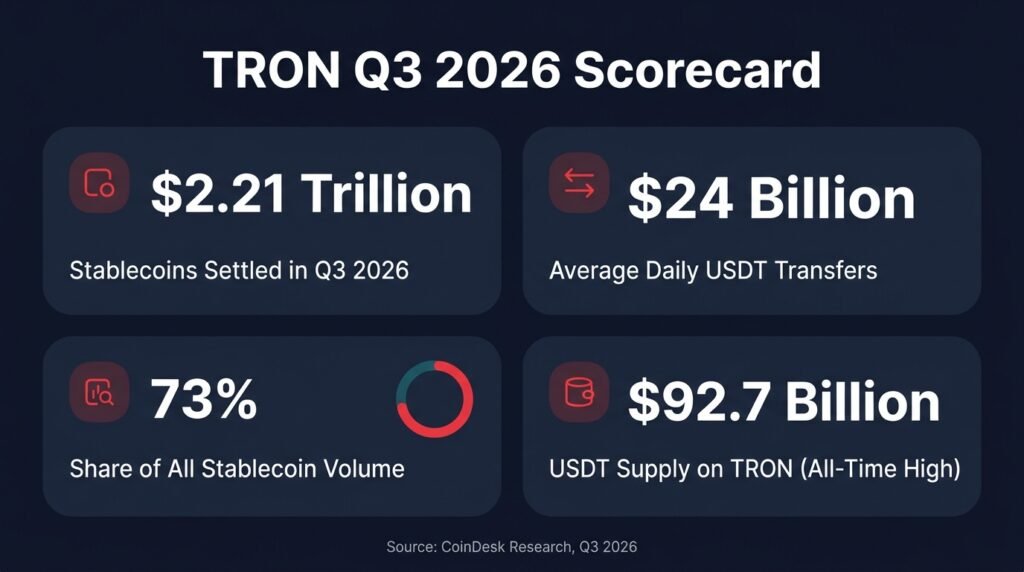
Stablecoin volume sits at the center of the TRON thesis. Reports show that TRON settled $2.21 trillion in stablecoins during Q3 2026, with daily USDT transfers averaging $24 billion. That figure dwarfs the activity on most competing chains. Merchants, exchanges, and remittance users generate these flows, and they keep returning because the network settles quickly and charges little. Repeat usage matters more than one-time spikes. When users circulate the same dollars again and again, they prove real demand rather than idle balances. Every circulation consumes energy and bandwidth, so volume feeds directly into token burning. Analysts also note that TRON handled roughly 73% of all stablecoin volume in Q3 2026, the highest share of any chain. Strong volume gives TRX holders a tangible fundamental to track each quarter. kucoinCoinDesk
How TRON Earns Money Through Network Fees
Fees tell investors whether a blockchain converts usage into value. TRON charges fees in two resources: energy and bandwidth. A USDT transfer consumes both, and users either stake TRX for free allowances or burn TRX to pay on demand. That burn removes tokens from circulation, which creates the deflationary pressure bulls love. The network does not cap its total supply, so burning offsets new issuance rather than guaranteeing scarcity. Net supply change therefore depends on activity levels and on the price of energy. When traffic rises, burning accelerates. When traffic or prices fall, burning slows. Investors who ignore this mechanism misunderstand the token. They should watch burn data alongside price, because burn data reveals whether fees support the narrative or undermine it.
Energy Prices, Fee Cuts, and Revenue Trends
Fee levels changed sharply after a governance vote in August 2025 that cut the energy unit price. Messari reported that fees rose 15.9% to $699.4 million in Q2 2026, their first quarterly increase since that governance change. CoinDesk Research measures a narrower figure and reported that total fees reached $82.7 million in Q3 2026, behind only Hyperliquid at $227 million. The two numbers differ because each firm defines fees differently, so readers should compare like with like. Cheaper transfers attract users, but they also shrink revenue per transaction. TRON therefore needs volume growth to outrun price cuts. So far, volume has delivered. Investors should still monitor the trade-off every quarter. You can read our wider coverage of fee-driven tokens on Scope Bitcoin. CointelegraphCoinDesk
The Q3 2026 Scorecard: Supply, TVL, and Price
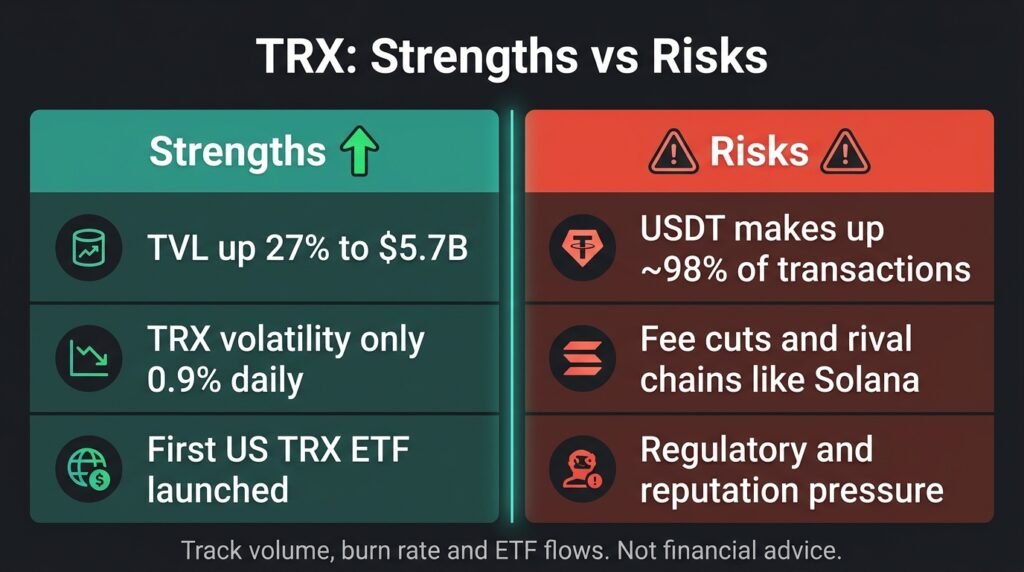
The third quarter gave bulls plenty of material. CoinDesk Research reported that USDT on TRON hit an all-time high of about $92.7 billion, while the network’s stablecoin market-cap share climbed to 30.2%. The same report noted that TVL rose 27% to $5.7 billion, and TRX gained 7% with only 0.9% daily volatility. Low volatility stands out in a market famous for violent swings. It suggests that TRX behaves more like infrastructure than a speculative coin. Earlier quarters showed steady progress too. In Q2, Messari counted 11.8 million daily transactions and 3.6 million active addresses. Together, these numbers show a network that grows without drama. Slow, steady growth rarely excites traders, but it often rewards patient holders. Our crypto market analysis tracks similar quarterly scorecards. TRON Network – Q3 2026 +2
Institutional Access and the First US TRX ETF
Institutions now enter the story. The same Q3 report highlighted the first US TRX ETF and wider institutional access. An ETF lets traditional investors buy exposure through a regular brokerage account. That convenience can expand the buyer base far beyond crypto-native users. Wallet providers and fintech firms also deepen the ecosystem. For example, MoonPay now offers zero-fee fiat onramps to TRON, which lowers the barrier for new users. More access does not guarantee higher prices, however. ETF inflows depend on investor appetite, and appetite shifts quickly. Still, regulated products give TRX a legitimacy it lacked in earlier cycles. Investors should watch ETF flows as a fresh demand signal in the months ahead. CoinDeskCoinDesk
What Could Go Wrong With TRON
Every honest outlook must examine the downside. TRON carries several risks that a single bullish quarter cannot erase. Concentration tops the list, because one stablecoin supplies almost all of the network’s traffic. Competition ranks second, since rival chains want the same payment flows. Regulation and reputation form the third cluster. Governance also deserves scrutiny, because a small group of validators and one prominent founder influence major decisions. None of these risks guarantees a decline. Each one, however, can change the investment case quickly. Investors who size their positions carefully survive bad news better than those who ignore it. The next three sections break these dangers into specific scenarios so you can weigh them yourself.
Heavy Dependence on Tether (USDT)
USDT accounts for nearly the entire stablecoin economy on TRON. Reports show that USDT made up nearly 98% of Q3 transactions. That concentration works brilliantly while Tether thrives. It becomes dangerous the moment Tether faces trouble. A regulatory action, a banking disruption, or a loss of confidence would hit TRON’s volume at once. Tether could also shift issuance toward other chains if economics change. Companies can redirect liquidity in days, and TRON cannot force them to stay. Investors should therefore treat Tether’s health as part of TRX’s risk profile. Diversification of stablecoin activity would reduce this exposure, but TRON has not achieved it yet. Until it does, the network’s fate stays tied to one issuer. kucoin
Fee Cuts and Rising Competition
Low fees attract users, yet they also invite rivals to undercut TRON. Solana already offers fast, cheap transfers, and several layer-2 networks keep pushing costs lower. A price war would hurt TRON’s revenue and its burn rate. One analysis warned that cutting fees by 50% would push on-chain TRX supply toward inflation. Treat that claim as a scenario rather than a forecast, because the outcome depends on volume. If volume doubles while fees halve, revenue holds steady. If volume stalls, holders suffer dilution. TRON also depends on rented energy markets, and energy costs can spike when the network gets overloaded. That volatility can frustrate users and push them toward alternatives. acsaorgacsaorg
Regulatory Pressure and Reputation Risk
TRON attracts criticism that its rivals sometimes avoid. Illicit actors use cheap stablecoin rails, and regulators watch those rails closely. Analysts have called TRON one of crypto’s most controversial projects, and that reputation can slow institutional adoption. Sanctions, enforcement actions, or exchange delistings in key regions would damage demand. Founder Justin Sun also draws legal and public scrutiny, which adds headline risk. The ETF milestone helps, but it does not remove these concerns. Compliance tools and partnerships may ease the pressure over time. Until then, investors should expect occasional negative news cycles. They should also check current regulatory developments in their own jurisdiction before they buy. Our guide to crypto regulation updates covers these shifts regularly. nexusfi
How to Evaluate TRX Before You Invest
A disciplined framework beats a gut feeling. Start with stablecoin supply and settlement volume, because those metrics drive everything else. Next, check fee revenue and the burn rate to see whether usage converts into token value. Then compare TRON’s market share against Solana, Ethereum, and the layer-2 networks. Finally, read the risk factors again and ask how much loss you can tolerate. Never invest money you need for rent, food, or emergencies. Consider splitting purchases over time instead of buying everything at once. Remember that this article offers information, not personalized financial advice, and that no author can predict prices. A licensed financial advisor can help you match any crypto position to your goals. For primary data, read the TRON DAO quarterly reports and compare them with independent research.
Frequently Asked Questions (FAQs)
Does TRX have a maximum supply?
No. TRON has no fixed cap. Supply adjusts through minting and burning, and burning grows with network activity.
Why does stablecoin volume matter for TRX?
Every USDT transfer consumes energy and bandwidth. Users pay for those resources with TRX or by staking it, so volume creates steady token demand.
Is TRX a safe investment?
No investment is safe. TRX showed low volatility recently, but regulation, Tether dependence, and competition can all hurt its price.
How much does a USDT transfer cost on TRON?
Costs vary with energy prices and wallet setup. One 2026 estimate put a typical transfer at roughly $1.00 to $3.50 of TRX without staked energy, while staking or renting energy cuts that cost sharply. acsaorg
Can ETFs push the TRX price higher?
They can raise demand by widening access, but they cannot guarantee gains. Flows depend on investor appetite.
Final Thoughts
TRON offers a clear investment story: it dominates stablecoin settlement, it earns meaningful fees, and it now reaches institutions through a US ETF. Those strengths deserve respect, and the data supports them. The risks deserve equal respect. Tether dependence, fee competition, and regulatory pressure could each undermine the thesis. Smart investors will track volume, burn rates, and ETF flows while they limit their exposure to a size they can afford to lose. This TRON (TRX) investment outlook gives you the facts, but you must make the final decision yourself. Continue your research with more guides at Scope Bitcoin.
