


This Litecoin trading guide shows you how to trade LTC in 2026 with a clear plan. Litecoin trades near $57 as of October 29, 2026, so the market offers both risk and opportunity. First, you will learn the strategies that fit today’s trend. Next, you will mark the key support and resistance levels. Finally, you will build risk rules that protect your capital. For more market updates, visit ScopeBitcoin.
Litecoin (LTC) Trading Guide 2026: Market Snapshot
Litecoin sits in a cautious phase as the year closes. LTC trades near $57 and sits below its 7-, 20-, and 50-day moving averages. However, the 200-day average near $52 is still below price. That gap tells you the long-term trend remains intact. The 14-day RSI reads about 40, which signals soft but neutral momentum. Bitcoin’s direction also steers most altcoins, including Litecoin. So check the Bitcoin chart before every LTC trade. Traders also watch volume, because weak volume makes breakouts unreliable. This Litecoin trading guide uses these facts as its starting point. Finally, prices change fast, so verify live data before you act. blockchain
Why Litecoin Still Attracts Traders
Litecoin has operated since 2011, so it carries a long track record. The network caps its supply at 84 million coins. That fixed supply creates scarcity, which supports long-term interest. Litecoin also confirms blocks faster than Bitcoin, so payments settle quickly. Fees stay low, which suits small transfers. Besides that, Litecoin merge-mines with Dogecoin, which strengthens network security. A first US spot Litecoin ETF has also launched, and the 2027 halving will cut new issuance in half. As a result, many traders treat LTC as a liquid, established altcoin. You can read the project’s basics on the official Litecoin website. primexbt
Best Litecoin Trading Strategies for 2026
No single strategy wins in every market. Therefore, you should match your method to the current trend. Right now, LTC leans bearish on short timeframes. That condition favors patient, selective setups over aggressive entries. First, pick one timeframe, such as the daily chart. Second, define your entry, stop, and target before you place a trade. Third, write your plan down and follow it. Also, avoid switching strategies after one losing trade. This Litecoin trading guide explains the three most practical approaches below.
Support and Resistance Strategy
This strategy suits range-bound markets like today’s LTC chart. First, mark the zones where price bounced several times. Then buy near support and sell near resistance. For example, analysts watch $56 as immediate support and $59 as first resistance. Wait for a candle close to confirm each bounce. Moreover, confirm the move with rising volume to avoid false signals. Place your stop loss just below the support zone. If support fails, exit quickly and reassess. This simple method forms the core of any Litecoin trading guide. blockchain
Moving Average Trend Strategy
Moving averages help you follow the trend instead of fighting it. Many traders use the 50-day and 200-day averages. When price trades above both, the trend favors buyers. When price trades below both, the trend favors sellers. Currently, LTC trades above the 200-day average but below the shorter averages. That mixed picture calls for caution and smaller positions. A daily close back above the 20-day average would improve the outlook. In contrast, a close below the 200-day average would warn of deeper losses. Therefore, let the averages guide your bias, not your emotions.
Halving and ETF Event Strategy
Events can move Litecoin more than charts do. The 2027 halving will cut new LTC issuance in half. Past halvings have preceded some of Litecoin’s strongest runs, according to analysts. ETF inflows can also lift demand. However, markets often price in big events early. So, do not buy blindly on headlines. Instead, build positions gradually in the months before the event. Also, take partial profits when hype peaks. Study this Litecoin price outlook from PrimeXBT for more event context.
Key Levels to Watch in This Litecoin Trading Guide
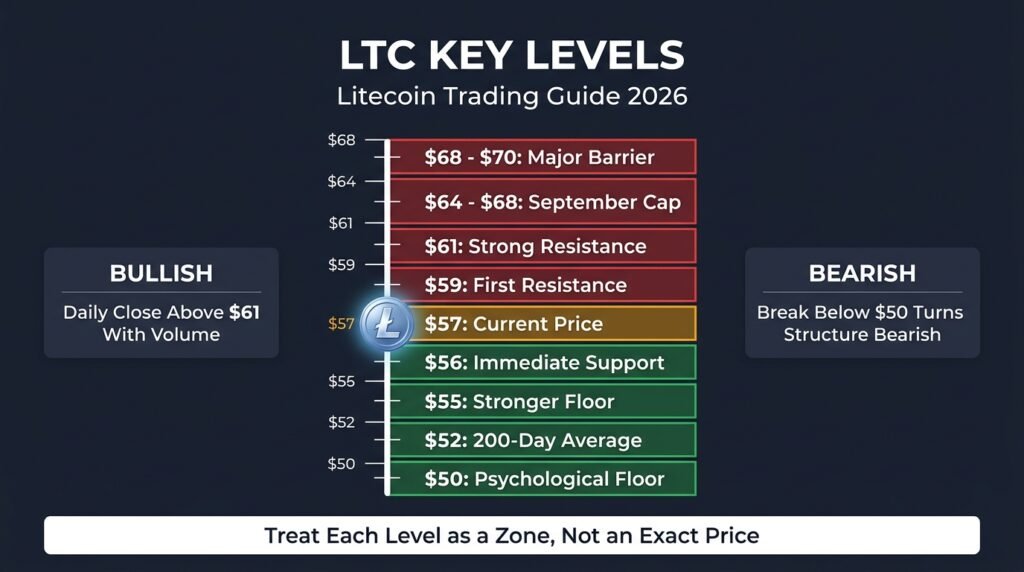
Key levels show you where buyers and sellers fight hardest. They also give you logical places for stops and targets. This section uses levels from recent technical studies. These levels shift, so update them often. Always draw your own zones on your own chart. Use daily candles for the strongest signals. Treat each level as a zone, not an exact price. Also, combine levels with volume and RSI readings. For a fresh view, read this LTC price prediction on Blockchain. News.
LTC Support Levels
Analysts mark $56 as immediate support and $55 as the stronger floor. Below that, the 200-day average near $52 offers deeper support. Another study places support near $52.50 on the four-hour chart. Meanwhile, $50 acts as a major psychological floor. A break below $50 would turn the structure sharply bearish. Therefore, watch these levels for bounce setups. If price holds, look for long entries with tight stops. If price breaks, avoid catching a falling knife. Wait for a base to form first.
LTC Resistance Levels
First resistance sits near $59. Strong resistance follows near $61. Next, the $64–$68 area capped rallies in September. Above that, the $68–$70 shelf acts as a major barrier. A daily close above $61 would signal improving strength. Then bulls could target $64 and beyond. However, wait for volume confirmation before you chase. Take profits in stages as price nears each zone. Also, move your stop up as the trade works.
Risk Management for Litecoin Traders
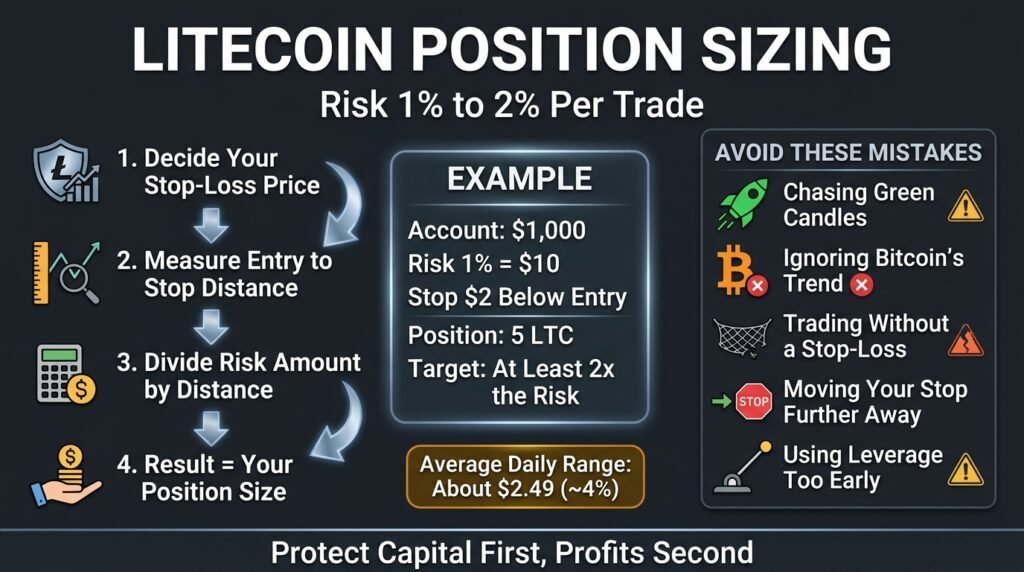
Risk management decides who survives in crypto. Litecoin can move several dollars in one day. For instance, the average daily range recently sat near $2.49. That range equals roughly 4% of today’s price. Therefore, size every trade with volatility in mind. Never risk money you cannot afford to lose. Also, avoid leverage until you gain consistent experience. Leverage multiplies losses as fast as profits. Keep a trading journal to track every decision. blockchain
Position Sizing and Stop-Loss Rules
Risk only 1% to 2% of your account on each trade. First, decide your stop-loss price. Next, calculate the distance between your entry and your stop. Then divide your risk amount by that distance. The result gives you your position size. For example, a $1,000 account risking 1% puts $10 at risk. If your stop sits $2 below entry, you can buy five LTC. Moreover, aim for a reward at least twice your risk. Never move a stop further away after you enter.
Common Mistakes to Avoid
Many traders chase green candles and buy tops. Others ignore Bitcoin and trade LTC in isolation. Some skip stop losses and hope for a recovery. Besides, overtrading drains both capital and focus. Emotional decisions also destroy good plans. Furthermore, traders often trust social media hype blindly. Instead, rely on data, levels, and your written plan. Also, never invest your emergency savings. Finally, read more guides on ScopeBitcoin to sharpen your edge.
FAQs About the Litecoin Trading Guide
Is Litecoin a good trade in 2026?
Litecoin offers strong liquidity and clear technical levels, but it still carries high risk. Short-term trends currently lean bearish. Trade only with a written plan and a stop-loss.
What is the best timeframe for trading LTC?
Beginners should start with the daily chart because it filters out noise. Experienced traders also use the four-hour chart to fine-tune entries.
Which Litecoin support level matters most?
Traders watch the $55–$56 band first. Then they watch the 200-day average near $52.
How much should I risk per trade?
Most traders risk 1% to 2% of their account on a single position. This rule keeps losing streaks survivable.
Does the Litecoin halving affect price?
The halving cuts new supply, and history shows it can boost demand. However, markets often price in the event months early.
Final Thoughts
This Litecoin trading guide gives you a simple framework for 2026. First, understand the current trend before you place any trade. Next, use support and resistance zones to plan your entries and exits. Also, let moving averages confirm your bias. Above all, protect your capital with strict risk rules. LTC currently trades in a cautious zone near $57. Therefore, patience will serve you better than speed. Remember that no guide guarantees profit. Do your own research, and never trade money you cannot afford to lose.
