


The Ethereum future scope extends far beyond a simple digital currency. Ethereum is a programmable blockchain where smart contracts execute agreements automatically, without relying on a traditional intermediary. This capability has powered decentralized finance, NFTs, stablecoins, and a growing ecosystem of applications. Now, traditional finance is paying attention, because the same technology could make settlement faster, cheaper,r and more transparent. In this guide on scopebit.com, we explore how smart contracts, tokenization, and institutional interest may shape the next era of financial markets. We also look at the risks, because understanding both sides is essential for any balanced view of Ethereum’s long-term potential.
What Makes Ethereum Different
Understanding Ethereum’s future scope begins with its design. Unlike Bitcoin, which focuses mainly on being digital money and a store of value, Ethereum is a general-purpose platform. Developers can build applications that run exactly as coded, with rules enforced by the network. This flexibility created a large developer community and the biggest ecosystem of decentralized applications in crypto. ETH, the native token, pays transaction fees and, since the move to proof-of-stake, secures the network through staking. This combination of utility and security gives Ethereum a distinct role, positioning it as infrastructure rather than only an investment asset.
Smart Contracts Explained Simply
A smart contract is code stored on the blockchain that automatically carries out actions when certain conditions are met. Think of a vending machine: you insert money, choose an item, and receive it without a cashier. Similarly, a smart contract can release payment when a delivery is confirmed or distribute dividends on a schedule. This reduces paperwork, delays,s and the need for trust between parties. Because the code is transparent and verifiable, users can inspect how it works. These features explain why the Ethereum future scope attracts attention from banks and asset managers seeking more efficient ways to handle complex financial agreements.
Proof-of-Stake and Network Efficiency
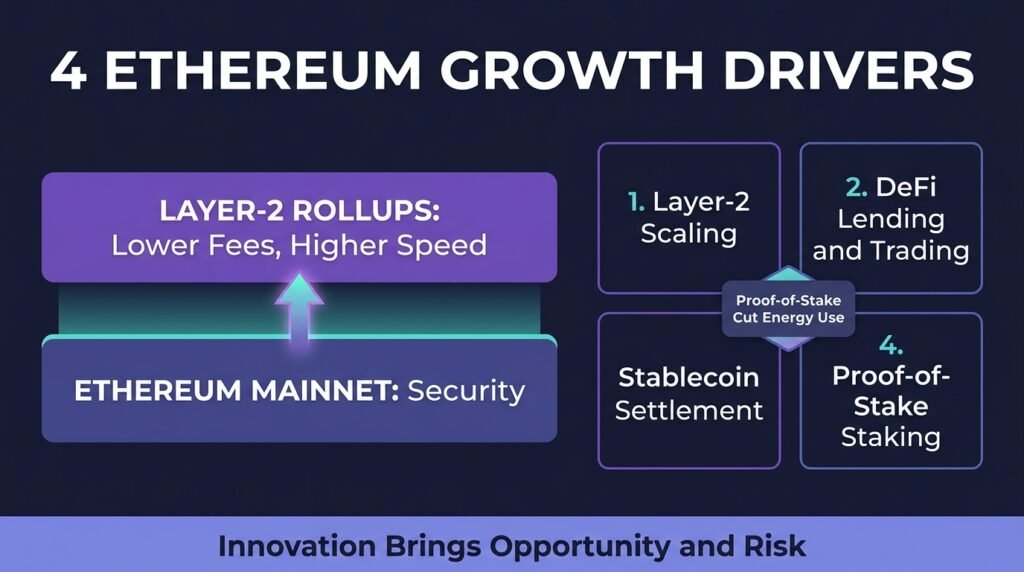
Ethereum’s shift to proof-of-stake dramatically reduced its energy consumption and changed how new coins are issued. Validators lock up ETH to help secure the network and earn rewards, aligning their incentives with network health. This change also supported a more predictable monetary policy, and fee-burning mechanisms can reduce supply during periods of heavy usage. Lower energy use also addresses environmental criticism that previously made institutions hesitant. Combined with ongoing upgrades focused on scalability, these improvements strengthen the Ethereum future scope by making the network more efficient, sustainable, le and attractive to large organizations with strict governance standards.
Tokenization and Wall Street
Tokenization means representing real-world assets, such as bonds, funds, or real estate, as digital tokens on a blockchain. This is one of the most discussed parts of the Ethereum future scope, because it could streamline how assets are issued, traded,d and settled. Traditional settlement can take days and involves multiple intermediaries, while on-chain settlement can happen in minutes. Major financial firms have already launched tokenized funds and pilot programs on public and permissioned blockchains. If these experiments scale, Ethereum could become part of the plumbing behind global capital markets, even if most users never interact with it directly.
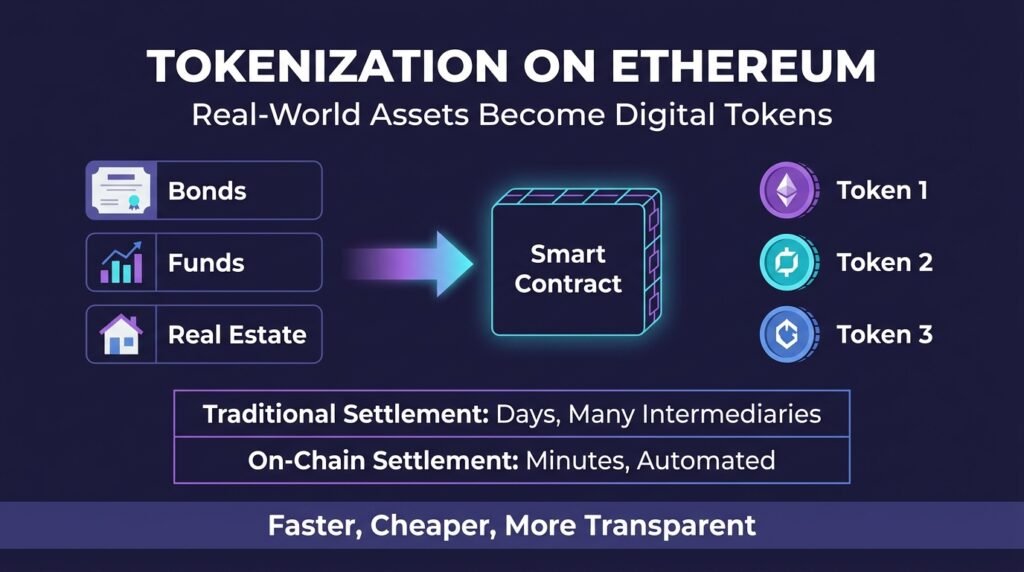
Tokenized Funds and Real-World Assets
Tokenized treasury funds and similar products allow investors to hold shares as blockchain tokens, which can be transferred or used as collateral more flexibly. Fractional ownership may open access to assets that were once reserved for large investors. Transparency and automated record-keeping can reduce administrative costs, while around-the-clock markets offer more convenience. Challenges include legal clarity, custody standards,s and ensuring that on-chain tokens correspond reliably to off-chain assets. You can review how regulators view such products through resources like the SEC. Progress in this area is a major driver of the Ethereum future scope over the coming years.
Faster Settlement and Lower Costs
Faster settlement reduces counterparty risk and frees up capital that would otherwise be locked during clearing. For large institutions, even small efficiency improvements can translate into significant savings at scale. Smart contracts can automate processes such as coupon payments, compliance checks, ks and collateral management. This may reduce operational errors and the need for manual reconciliation. Yet integration with existing systems is complex, and firms must satisfy strict regulatory and cybersecurity requirements. The speed of adoption will depend on how effectively blockchain solutions can fit into established workflows, which is why the Ethereum future scope is promising but not guaranteed.
DeFi, Stablecoins and Layer-2 Growth
Decentralized finance shows what programmable money can do. Users can lend, borrow, and trade through smart contracts without a traditional bank, and stablecoins provide a relatively steady unit of account on-chain. Ethereum hosts a large share of DeFi activity and stablecoin supply, giving it deep liquidity and network effects. These elements strengthen Ethereum’s future scope because they demonstrate real, working financial applications. At the same time, DeFi has seen hacks, bugs, and failures, reminding users that innovation carries risk. Careful research and caution are necessary when interacting with any protocol.
Layer-2 Networks and Scalability
Layer-2 networks process transactions off the main chain and then settle results back on Ethereum, reducing fees and increasing throughput. Rollups have become a core part of Ethereum’s scaling strategy, allowing everyday transactions to cost much less. This matters because high fees in busy periods once pushed users away. Cheaper transactions make new use cases viable, including payments, gaming,g and micro-transactions. However, the growth of multiple layer-2 networks can fragment liquidity and complicate user experience. Improving interoperability is therefore a key priority and a significant factor in the long-term future of Ethereum.
Stablecoins as a Growth Engine
Stablecoins are among the most widely used crypto products, serving traders, businesses, and individuals needing fast transfers. Much of this activity runs on Ethereum and its layer-2 networks, generating fees and increasing demand for blockspace. Regulators in many regions are developing rules for stablecoin issuers, which could improve trust and attract more institutional use. If banks and payment companies expand stablecoin offerings, Ethereum could benefit as a settlement layer. Still, competition from other blockchains is strong, and regulation may shape which designs succeed. This is a vital area to monitor when assessingEthereum’sm future scope.
Risks and Challenges Ahead
No analysis of the Ethereum future scope is complete without discussing risks. Competing blockchains offer lower fees or faster speeds, and some may attract developers and capital away from Ethereum. Regulatory uncertainty around staking, DeFi, and token classification could affect institutional participation. Security vulnerabilities in smart contracts remain a concern, as bugs can lead to large losses. Network upgrades are complex, and delays or errors could harm confidence. Market volatility also affects ETH price, regardless of technological progress. Understanding these challenges helps investors maintain realistic expectations and manage exposure carefully.
Competition From Other Blockchains
Several smart contract platforms compete by emphasizing speed, low cost, or specialized features. Some have gained traction in areas like gaming, payments,s and consumer applications. Ethereum’s advantages include security, decentralization, development talent,nt and deep liquidity, which are difficult to replicate quickly. However, it must continue improving user experience and reducing costs to stay competitive. Observers can compare activity across networks using data platforms such as DefiLlama. Healthy competition may push innovation forward, but it also means the Ethereum future scope depends on execution, not just reputation.
Practical Tips for Investors
Treat ETH as a high-risk asset and size positions according to your tolerance. Avoid investing borrowed money, diversify across assets,ets and consider dollar-cost averaging to reduce timing risk. Use reputable exchanges and secure wallets, and be careful with unfamiliar DeFi protocols or tokens. Follow credible news sources and ignore guaranteed profit claims. Review your thesis regularly as technology and regulation evolve. A patient, informed approach is far more reliable than chasing hype, and it helps you benefit from long-term trends in the Ethereum future scope while protecting yourself from avoidable mistakes.
FAQs
1. What is the Ethereum future scope?
It refers to Ethereum’s long-term potential in areas such as smart contracts, tokenization, DeFi, i and institutional finance. Growth depends on adoption, scalability, utility, and regulation.
2. How could smart contracts help Wall Street?
They can automate settlement, payments, and compliance, reducing delays and costs. Adoption requires legal clarity and integration with existing systems.
3. Is Ethereum better than Bitcoin?
They serve different purposes. Bitcoin is mainly a store of value, while Ethereum is a programmable platform for applications.
4. What are the biggest risks for ETH?
Key risks include competition, regulation, smart contract vulnerabilities, and market volatility. Always research thoroughly before investing.
Conclusion
The Ethereum future scope is closely tied to smart contracts, tokenization, DeFi, i and the possibility that Wall Street adopts blockchain infrastructure for settlement and asset issuance. Proof-of-stake, layer-2 scaling, and growing institutional experimentation strengthen the case, while competition, regulation,n and security risks remain real. Stay informed, diversify,fy and invest responsibly. For more guides and market insights, visit scopebit.com. This article is for educational purposes and is not financial advice.
