

Shibarium has changed how the Shiba Inu community uses its tokens. Before it existed, SHIB holders paid Ethereum gas fees for every transfer, swap, and game purchase, and those costs often swallowed small trades. The Shiba Inu team answered with Shibarium, a Layer 2 network that processes transactions away from the Ethereum mainnet and settles them back to it. This guide explains what Shibarium does, how its parts fit together, and which projects run on it. You will learn about the BONE gas token, the validators, the bridge, and the burn mechanism. We also cover the real risks so that you can judge the network with clear eyes. For more crypto explainers, visit Scope Bitcoin.
What Is Shibarium?
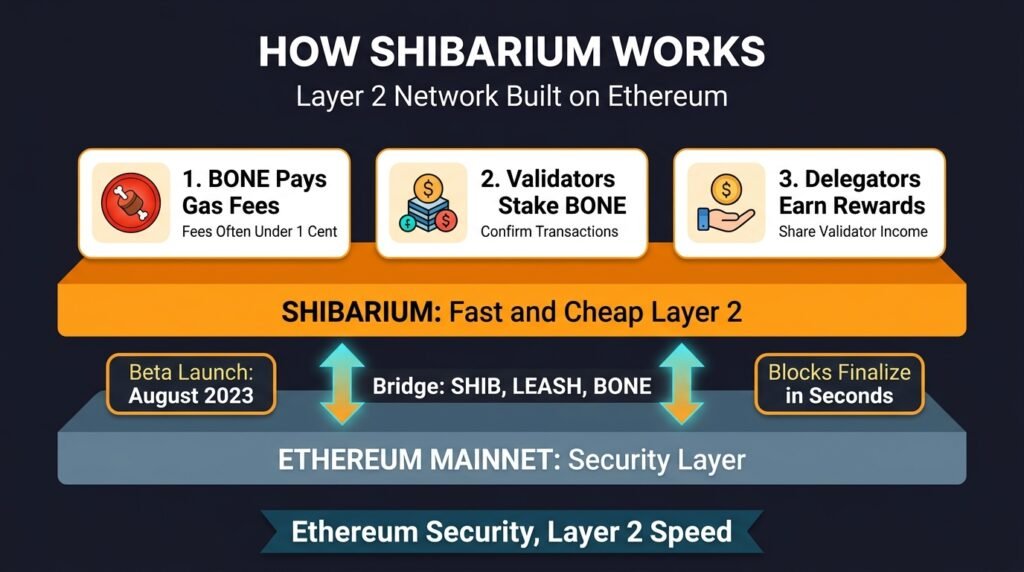
Shibarium is the official Layer 2 blockchain of the Shiba Inu ecosystem. The team launched it in beta in August 2023, and it gave the community its own home chain for the first time. A Layer 2 network sits on top of a main blockchain, and it handles transactions faster and cheaper than the base layer. Shibarium uses Ethereum for security, so users keep the safety of a proven network. Developers can build apps, games, and marketplaces on Shibarium without paying high Ethereum fees. The network also supports Ethereum-compatible smart contracts, which means developers can reuse familiar tools. In short, Shibarium turns SHIB from a simple meme coin into the base of a working digital economy. You can read the team’s own updates on the official Shiba Inu website.
Why Shiba Inu Needed Shibarium
Shiba Inu began in August 2020 as a community token on Ethereum. The token grew fast, yet it had a big weakness: it relied entirely on Ethereum, and Ethereum charges high fees during busy periods. A simple SHIB swap could cost more than the trade itself, and that discouraged everyday use. Developers also had little reason to build on a chain where every action drained their users’ wallets. The team saw that a meme coin cannot grow into an ecosystem without cheap, fast transactions. Shibarium solved three problems at once:
- It cut transaction costs for small users.
- It gave developers a stable base for new apps.
- It created a way to reward the community for supporting the network.
Those goals explain nearly every design choice behind Shibarium.
How Shibarium Works as a Layer 2 Network
Shibarium processes transactions on its own chain, and it then sends proof of that activity back to Ethereum. This process lets the network handle many actions quickly without crowding the main chain. The team built Shibarium on a Proof-of-Stake model, so validators who lock up tokens keep the network honest. Users interact with it much as they would with Ethereum, because the network supports the same wallets, such as MetaMask. A user adds the Shibarium network to the wallet, bridges funds, and starts transacting. Blocks arrive in seconds, and fees stay far below Ethereum levels. This design keeps the experience simple for newcomers while it gives builders the speed they need. Three components deserve a closer look.
The BONE Token and Gas Fees
BONE is the gas token of Shibarium. Every user pays transaction fees in BONE, just as Ethereum users pay in ETH. The Shiba Inu team originally introduced BONE as a governance token inside ShibaSwap, and the community now uses it to keep the chain running. Because BONE pays for every action, demand for it grows when more people use the network. Fees stay tiny, often a fraction of a cent, so even small payments make sense. The network also rewards participants who help secure the chain with BONE. This setup ties the token directly to real network activity. Anyone who wants to use Shibarium needs a small amount of BONE in the wallet before the first transaction.
Validators and Delegators
Validators run the computers that confirm transactions on Shibarium. They stake BONE as a security deposit, and the network punishes bad behavior by cutting that stake. Honest validators earn a share of the transaction fees for their work. Regular holders who lack the technical skill can still take part as delegators. A delegator assigns BONE to a validator, and in return the delegator earns a portion of the rewards. This system spreads the work and the profit across the community instead of a single company. It also strengthens security, because more staked tokens make attacks more expensive. Anyone who wants passive income from the network can study validator performance before choosing where to delegate.
The Bridge Between Ethereum and Shibarium
The Shibarium bridge moves tokens between Ethereum and the Layer 2 chain. A user locks SHIB, LEASH, or BONE on Ethereum, and the bridge releases the matching amount on Shibarium. The reverse process brings tokens back to Ethereum when the user wants to leave. This tool matters because it connects the old Shiba Inu world with the new one. However, bridges also attract hackers across the whole crypto industry. In September 2025, an attacker exploited the Shibarium bridge and stole millions of dollars in tokens, and the team paused parts of the network to respond. Users should always check official channels before they bridge funds and should never bridge more than they can afford to risk.
Shibarium and the SHIB Burn Mechanism
Token burning plays a major role in the Shiba Inu story. SHIB has a huge supply, and holders have long asked how the project can shrink it. Shibarium gives the community a new tool for this goal. The team linked network activity to burns, so more transactions can lead to more tokens leaving circulation. Community burn trackers show the totals, and many holders watch those numbers closely. A burn does not guarantee a higher price, because demand decides value. Still, the mechanism shows that the team wants usage to feed back into scarcity. Readers should treat burn claims with care and check the data on trusted trackers before they act on any headline.
Key Features of Shibarium
Shibarium offers several features that make it attractive to both users and developers. The most important ones include:
- Low fees: Transactions cost a tiny fraction of Ethereum’s gas prices.
- Fast confirmation: Blocks finalize in seconds, which suits games and payments.
- Ethereum compatibility: Developers deploy existing smart contracts with little change.
- Community staking: Holders earn rewards through delegation.
- Burn support: Network use feeds token burns that cut supply.
- Own ecosystem: SHIB, LEASH, and BONE all find a real job on one chain.
Together, these strengths give builders a reason to launch on Shibarium. They also give everyday holders a reason to stay active instead of simply waiting for price moves.
Shibarium Ecosystem Projects
The ecosystem around Shibarium keeps growing as new teams join. Each project gives SHIB, LEASH, and BONE more ways to earn their place. Some projects focus on finance, while others focus on play and culture. The team also encourages outside developers to launch their own tools, because a lively chain needs many apps. Users who explore the ecosystem can swap tokens, stake assets, collect digital items, and join community events. This variety separates a real network from a one-feature chain. Two areas stand out for most newcomers.
ShibaSwap
ShibaSwap is the decentralized exchange of the Shiba Inu world. Users swap tokens, provide liquidity, and earn rewards without a central company holding their funds. The exchange started on Ethereum, and the team has since moved much of its activity toward Shibarium to cut costs. Liquidity providers deposit token pairs and receive a share of trading fees. Stakers can lock tokens to earn more, and the platform ties directly into BONE and LEASH. Lower fees on Shibarium make small trades practical again. A new user should start with a small test swap, confirm the result, and only then move larger amounts.
Games and Metaverse
Gaming and virtual worlds give Shibarium its most visible public face. Shib: The Metaverse lets users own virtual land and take part in community events. Shiba Eternity brings a mobile card-battle game to the ecosystem, and its in-game items connect to the broader token economy. These projects need cheap and fast transactions, because players will not pay high fees for each move or purchase. Shibarium meets that need far better than Ethereum does. Games also bring people who do not follow crypto charts, so they widen the audience. Success in this area could do more for adoption than any price rally.
Shibarium vs Ethereum Mainnet
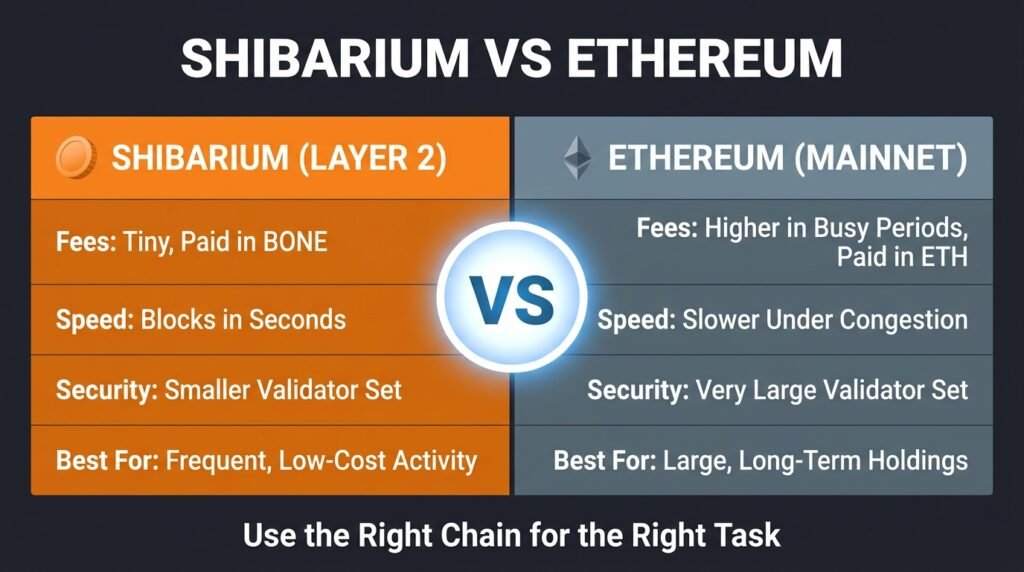
Shibarium and Ethereum serve different roles, and understanding the contrast helps new users. Ethereum acts as the secure foundation, while Shibarium acts as the fast and cheap workspace on top of it. Ethereum has far more users, more developers, and deeper liquidity. Shibarium has lower costs, faster blocks, and a community that focuses on one ecosystem. Ethereum validators number in the hundreds of thousands, so the base layer offers stronger decentralization. Shibarium has a much smaller validator set, and that gives it less raw security on its own. Many users hold assets on both chains and move between them as needed. Choose the chain that matches the task: Ethereum for large, long-term holdings, and Shibarium for frequent, low-cost activity.
Risks and Challenges of Shibarium
Every young blockchain faces real risks, and Shibarium is no exception. The 2025 bridge exploit proved that security gaps can cost users money. Network activity has also stayed lower than the community hoped at times, and a quiet chain struggles to attract builders. Competition is fierce, because many other Layer 2 networks offer similar speed and cost. Price swings remain wild for SHIB, LEASH, and BONE, so investors can lose money quickly. Smaller validator sets add some centralization risk as well. Before you commit funds, read the official announcements, test with small amounts, and never invest more than you can afford to lose. Nothing here counts as financial advice.
The Future of Shibarium
The Shiba Inu team keeps adding features, and the community watches several goals closely. These include stronger security after the bridge incident, new decentralized apps, and better tools for developers. The team has also discussed privacy features and further scaling upgrades to keep the network competitive. Partnerships with outside projects could bring more users and more liquidity. Real growth will depend on steady usage, not on hype. If developers keep shipping useful products, Shibarium can build a lasting place among Layer 2 networks. If activity stays thin, rivals will take the lead. Follow trusted news sources, such as Scope Bitcoin, to track each new update as it arrives.
Conclusion
Shibarium gives the Shiba Inu community a faster and cheaper home than Ethereum alone can offer. The BONE token pays for transactions, validators and delegators secure the chain, and the bridge links everything back to Ethereum. Projects such as ShibaSwap and Shib: The Metaverse show how the network can serve finance and play. The burn mechanism adds another reason for holders to watch network activity. At the same time, the bridge exploit and the strong competition remind everyone that risk is real. Do your own research, start small, and verify every link and address. Shibarium has taken a big step for SHIB, and its next chapter will depend on real adoption. Visit Scope Bitcoin for more guides on meme coins and blockchain technology.
