

Polkadot DOT stands out as one of the most ambitious multi-chain networks in crypto. Originally, Gavin Wood, a co-founder of Ethereum, designed it to connect many blockchains into one system. Instead of operating as isolated networks, Polkadot lets different chains share security and exchange data. At the same time, the DOT token powers this system through staking, governance, and network fees. In this guide, we will explain each part in simple terms. For additional market context, browse the latest guides on Scope Bitcoin.
What Is Polkadot DOT?
Polkadot is a Layer 0 network that links independent blockchains under one shared framework. Initially, the Web3 Foundation supported its development, and the main network went live in 2020. Since then, developers have built their own chains on Polkadot and customized them for specific uses, such as finance, gaming, or identity. Moreover, these chains can communicate with each other without relying on outside bridges. Meanwhile, DOT remains the native token, and holders use it to secure the network and vote on its future.
How the Polkadot DOT Relay Chain Works
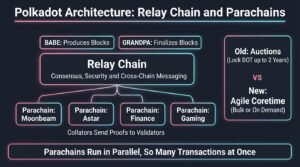
The Relay Chain acts as the heart of the network. In particular, it handles consensus, security, and cross-chain communication, but it does not run complex apps itself. Instead, validators produce and confirm blocks on the Relay Chain while also verifying the work of connected chains. As a result, this division keeps the core simple and efficient. At the same time, developers can focus on their own products while the Relay Chain protects every connected chain. Furthermore, the network finalizes blocks quickly, so users can receive reliable confirmations.
Consensus and Finality on the Relay Chain
Polkadot combines two protocols to reach agreement. First, BABE produces new blocks at a steady pace. Then, GRANDPA finalizes groups of blocks together. As a result, this pairing gives the chain both speed and strong finality. Once GRANDPA finalizes a block, it cannot normally be reversed. In addition, validators vote in rounds, and the network accepts the result when enough of them agree. Therefore, the design helps Polkadot support many chains without unnecessarily slowing down the network.
How Polkadot Parachains Work
Parachains are independent blockchains that run in parallel on Polkadot. For example, each parachain can have its own rules, token, and purpose, allowing teams to design exactly what they need. Meanwhile, collators gather transactions and send proofs to Relay Chain validators for checking. Because parachains run side by side, the network can process many transactions at once. For instance, projects like Moonbeam and Astar use this model to serve different communities. Additionally, you can explore active projects on the official Polkadot website.
How Agile Coretime Replaced Parachain Auctions
Previously, parachains won slots through auctions, where supporters locked DOT for extended periods. However, Polkadot later replaced that system with Agile Coretime. Now, teams can buy blockspace in flexible amounts, either in bulk or on demand. As a result, this change lowers the cost of entry for smaller projects. Instead of committing large amounts upfront, builders can pay for the capacity they actually need. Consequently, more teams can launch and test ideas on the network.
How Polkadot DOT Shared Security Works
Shared security means every connected chain uses the same validator set for protection. In other words, a new chain does not need to recruit its own validators or build an entirely separate security system. Instead, Relay Chain validators check each parachain block and reject invalid ones. Therefore, an attacker would have to overcome the security of the wider network rather than targeting only one small chain. As a result, newer projects can benefit from the same shared security model as established projects. Furthermore, this approach keeps the security budget within one broader network.
How Cross-Chain Messaging Works on Polkadot
Polkadot uses a messaging format called XCM to move data and assets between chains. In simple terms, a chain sends an XCM message, and the network delivers it to the target chain. Moreover, the format supports token transfers, contract calls, and other actions. Because this communication is built into the ecosystem, users can avoid relying on many third-party bridges. At the same time, developers can save time because they use a common standard across connected chains. For more technical information, the official Polkadot documentation explains XCM in greater detail.
How the Polkadot DOT Token Works
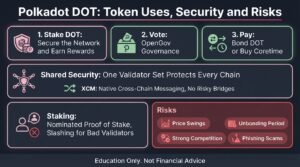
DOT serves three main purposes. First, holders can stake it to help secure the network and potentially earn rewards. Second, they can use it to participate in governance and vote on proposals. Finally, teams can use DOT in connection with network resources, including coretime. In addition, Polkadot’s token economics include ongoing issuance rather than a fixed hard cap. Therefore, the supply can increase over time as the protocol distributes rewards. For current market information, you can track live price and supply data on CoinGecko.
Staking and Governance on Polkadot DOT
Polkadot uses nominated proof of stake to select its validators. Under this system, nominators back trusted validators with their DOT, while the network rewards participants according to its staking rules. However, validators that break network rules can face penalties, including slashing. Meanwhile, governance operates through OpenGov, where holders can submit and vote on proposals. Furthermore, voting power can depend on factors such as the amount of DOT used and the selected conviction or lock period. As a result, the system gives the community a direct role in network upgrades and funding decisions.
Risks of Using Polkadot DOT
Every crypto network carries risk, and Polkadot is no exception. First of all, DOT’s price can fluctuate significantly, while staking can involve an unbonding period. Furthermore, Polkadot faces competition from Ethereum rollups, Cosmos, and other multi-chain projects. At the same time, some parachains may attract less activity than others, which can affect the wider ecosystem. In addition, smart contract bugs, phishing attacks, and other security threats can put users at risk. Therefore, research every project carefully before investing. For more beginner-friendly information, you can also read guides at Scope Bitcoin.
FAQs About Polkadot DOT
What is Polkadot DOT used for?
Holders use DOT for staking, governance voting, and accessing network resources. In addition, DOT plays an important role in the wider Polkadot ecosystem.
What is the difference between the Relay Chain and parachains?
The Relay Chain provides core security and coordination, while parachains run their own applications and follow their own rules. Therefore, both components have different but connected responsibilities.
How does Polkadot share security?
Relay Chain validators check parachain blocks, so connected chains can rely on the shared security of the wider network.
Can beginners stake DOT?
Yes, beginners can nominate validators through supported wallets. However, they should understand staking requirements, risks, and the unbonding period before committing their DOT.
Final Thoughts
Overall, Polkadot offers a clear vision: many specialized chains that share security and communicate with each other. At the center of this design, the Relay Chain protects the network, while parachains provide customized functionality. Meanwhile, DOT connects important parts of the ecosystem through staking, governance, and network resources. However, the project still faces strong competition and market risks. Therefore, users should study the technology, compare alternatives, and understand the risks before making financial decisions. Ultimately, this guide is intended for education and should not be considered financial advice.
