

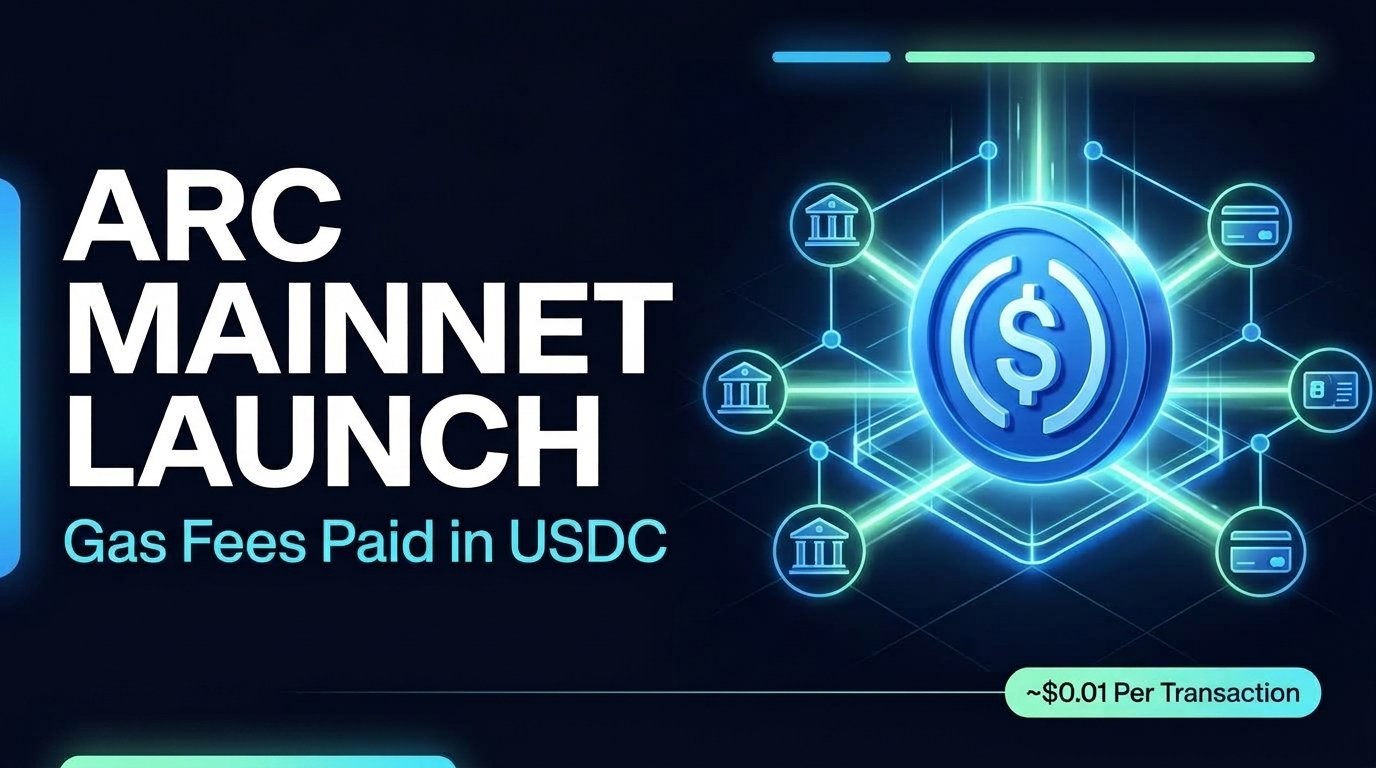
The Arc mainnet launch is one of the biggest stablecoin stories of 2026, because Circle, the company behind USDC, now runs its own blockchain. Most networks ask users to pay fees in a volatile coin like ETH, which makes costs hard to predict. Arc takes a different path and uses USDC itself as the gas asset. Circle opened the public network in September 2026 with large financial names as validators. In this guide, we explain how the launch happened, how USDC gas fees work, what makes Arc different, and which risks you should understand before moving funds.
What Is the Arc Mainnet Launch?
The Arc mainnet launch means that Circle’s stablecoin-focused layer-1 blockchain is now open to the public. Circle describes Arc as an open network built for financial markets, real-time money movement, and payments run by software agents. It is compatible with the Ethereum Virtual Machine, so developers can use Solidity contracts and familiar tools. Before the public opening, Arc ran as a private mainnet with more than 100 builders testing it. The goal is simple: give banks, payment firms,s and developers a fast and predictable home for dollar-based finance. You can read the official details on the Circle website.
Arc Mainnet Launch Date and Founding Validators
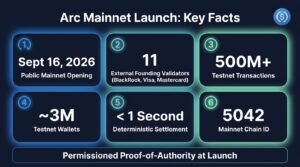
Circle set the public opening for September 16, 2026, and announced it on a Wednesday. The network started with 11 external founding validators, including big names such as BlackRock, Visa and Mastercard. Before launch, the Arc testnet reportedly processed more than 500 million transactions across nearly 3 million wallets. Aave, Morpho and Uniswap were also expected to bring lending and trading tools. At launch, Arc runs under a permissioned Proof-of-Authority model, which means only approved validators secure the chain. This gives speed and institutional comfort, but it is less open than networks that anyone can validate.
How USDC Gas Fees Work on Arc
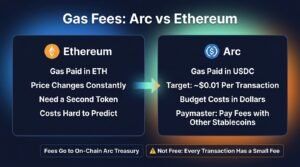
Gas fees are the cost of sending a transaction, and on Arc they are paid in USDC instead of ETH or another volatile token. This is the heart of the Arc mainnet launch story. A business can budget costs in dollars without buying a separate coin that may change price tomorrow. Circle is targeting roughly one cent per transaction, although real costs can change with demand. Fees go to an on-chain Arc Treasury. Circle also supports a Paymaster feature, which lets users pay fees with other approved stablecoins. Arc does not promise free transfers, so every transaction still carries a small fee.
Arc Gas Fees Compared With Ethereum Gas Fees
On Ethereum, you must hold ETH to pay gas, even if you only want to move dollars. When ETH rises, or the network is busy, a simple transfer can become expensive and confusing. Arc tries to remove this problem by making the fee asset the same as the money being moved. A user who bridges USDC to Arc can spend that same balance on fees, so there is no second token to manage. Fees are also designed to stay stable when demand changes. This does not make Arc cheaper in every case, but it makes costs easier to plan, which matters for companies and automated payment systems.
Key Technical Features of Arc
Arc offers deterministic settlement in under one second, which means a transaction becomes final almost immediately instead of waiting for many confirmations. This is useful for payments, trading, and tokenized assets, where delays create risk. The mainnet uses chain ID 5042, which wallet users need when adding the network manually. Circle also plans an opt-in privacy feature after launch, designed to hide amounts while keeping addresses visible for compliance. At launch, Arc supports many fiat-backed stablecoins and tokenized funds such as BUIDL and USYC. Together, these tools show that Arc is built for institutions first, with retail users following later.
The Double USDC Detail Every User Should Know
One confusing point is that Arc shows USDC in two ways. The native gas balance uses 18 decimals, while the familiar token version uses 6 decimals. Circle tells wallets to show a single USDC row and divide the larger figure by 10 to the power of 12. If an app displays this wrongly, your balance may look far bigger than it really is. Before launch, some people even paid a premium to get early access to Arc-side USDC through informal marketplaces. Always use official bridges such as CCTP or the Circle bridge, and read the Decrypt guide to Arc first.
What About the ARC Token?
Many readers ask whether a new coin comes with the Arc mainnet launch. Circle minted 10 billion ARC tokens at genesis, but it clearly states that this is not a commitment to a public token launch. No ARC token trades publicly today, and the company has not shared a public launch date. Reports indicate that Circle raised $222 million through a token presale in May 2026, and network participants reserved 60 percent of the supply. No one has published a snapshot or eligibility rules yet. Be careful with fake airdrops, because scammers often use unannounced tokens to steal wallet access.
Risks and Limits After the Arc Mainnet Launch
A new network always carries risks. Arc uses a permissioned validator set, so decentralization is lower than on older chains. Bridges and new apps can contain bugs, and wrong network selection can lock funds temporarily. USDC itself is a centralized stablecoin, so issuer decisions and regulation matter. Circle’s business also depends on interest from reserves, which can change with rates. Liquidity may start small, so large transfers can face higher costs. Start with a tiny test transaction, double-check addresses, and follow trusted updates on Cope Bitcoin. This is not financial advice.
FAQs About the Arc Mainnet Launch
When was the Arc mainnet launch?
Circle opened the public Arc mainnet in September 2026, with the planned date set for September 16, 2026.
What are the gas fees on Arc?
Gas fees are paid in USDC. Circle is targeting about one cent per transaction, but actual fees can change with network demand.
Do I need ETH to use Arc?
No. USDC is the native gas asset on Arc, so you do not need ETH to pay fees on this network.
Is there an ARC token I can buy?
Circle minted 10 billion ARC tokens, but it says no public token launch has happened and no launch date is confirmed.
Is Arc safe to use?
It has strong institutional validators, but it is new and permissioned at launch. Use official bridges, test with small amounts, and avoid unofficial airdrop links.
Final Thoughts on the Arc Mainnet Launch
The Arc mainnet launch shows that stablecoin issuers want to control more of the infrastructure behind digital dollars. Paying gas in USDC is a simple idea that solves a real problem for businesses and everyday users. The network is still young, validators are limited, and the ARC token story is unclear, so patience is wise. Watch real usage, fee levels, and ecosystem growth over the coming months. For more daily crypto coverage and stablecoin updates, keep reading Cope Bitcoin.
