

Tether’s future scope depends on one big question: can USDT keep its crown while regulators close in? USDT leads the stablecoin market by a wide margin, and traders use it everywhere. However, new laws in the United States and Europe now test the company’s model. Tether has responded with new products, audits, and a fresh US strategy. This guide explains where USDT stands, what threatens it, and what could help it stay on top. For more market coverage, visit Scope Bitcoin.
Tether Future Scope: Where USDT Stands Today
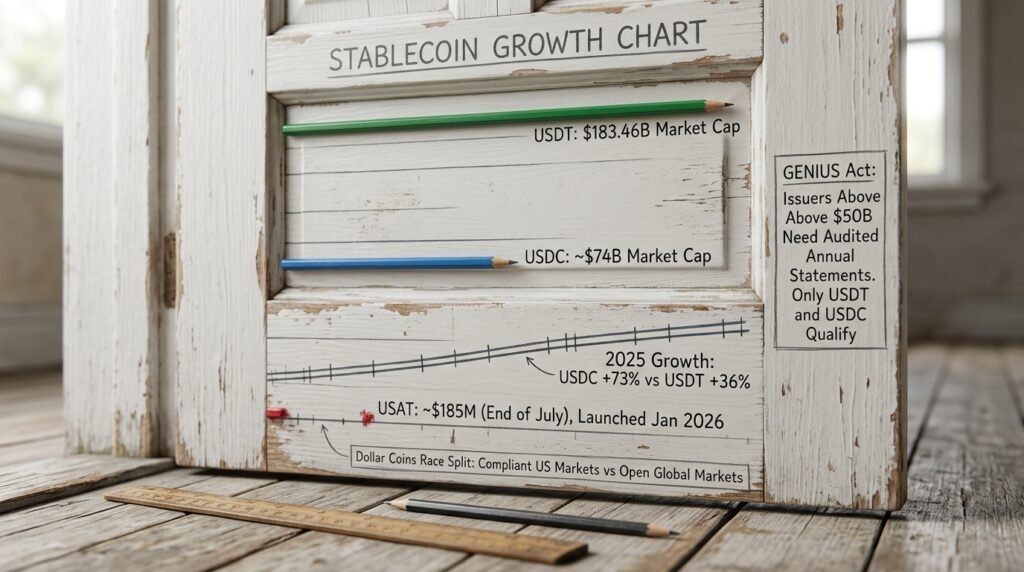
USDT still dominates the stablecoin market in 2026. CoinDesk’s tracker shows that Tether holds a market cap of about $183.46 billion. Circle’s USDC trails far behind, with roughly $74 billion in circulation. Traders use USDT as the default trading pair on most major exchanges. It also moves huge volumes across many blockchains every day. This scale gives Tether a deep liquidity advantage that rivals struggle to copy. Still, scale alone does not protect a company from new rules. You can check live numbers on CoinGecko. CoinDeskshattered
How USDT Became the Top Stablecoin
Tether launched USDT in 2014 and built early ties with crypto exchanges. Traders needed a dollar substitute that moved fast between platforms, and USDT filled that gap. Exchanges then listed it as a base trading pair, which created a strong network effect. More traders used it because more markets supported it. Over time, USDT also spread to Tron and Ethereum, where fees and speed attracted users in many countries. Competitors entered later and fought for the same liquidity. Tether kept its lead because users trusted the convenience of the coin they already held.
How the GENIUS Act Affects Tether
The GENIUS Act created the first federal framework for payment stablecoins in the United States. President Trump signed it into law on July 18, 2025. The law sets rules for reserves, disclosures, and licensing. It pushes issuers to hold safe, liquid assets such as cash and short-term Treasuries. Tether operates from El Salvador, so it faces a different path than US-based issuers. The company can seek registration as a foreign issuer, or it can serve US users through a separate product. Treasury has also moved forward with implementation. A report noted that Treasury finalized the first binding GENIUS rule on September 30, 2026. dgitech-insider
The $50 Billion Audit Rule
The GENIUS Act adds a tougher standard for large issuers. Any issuer with more than $50 billion in tokens must file audited annual financial statements instead of quarterly attestations. Only two stablecoins clear that line today: USDT and USDC. Circle already works under strict US disclosure habits, so it adapts more easily. Tether has used attestations from an outside accounting firm, and it has promised more transparency. A full audit would give the market more confidence. It would also expose every weakness in the reserve mix. Traders therefore watch this issue closely. shattered
Tether’s USAT Strategy for the US Market
Tether decided not to rebuild USDT for American rules. Instead, it launched a second coin called USAT. Tether introduced USAT in January 2026 as a dollar-pegged stablecoin built for the US market under the GENIUS Act. Anchorage Digital issues it, and the design follows the law’s reserve and compliance standards. This two-track plan lets USDT keep serving global users while USAT targets American customers. The approach carries a cost, though. USAT remains tiny, and its market cap sat near $185 million at the end of July. Building liquidity takes time. Tether must convince US exchanges and institutions to adopt it. dgidgi
MiCA and Global Rules Facing USDT
Europe adds a second pressure point through its MiCA framework. MiCA sets strict rules for stablecoin issuers that serve EU customers, including reserve and licensing standards. After the rules took effect, several European exchanges limited USDT access for regional users. Tether never secured MiCA authorization for USDT, so retail access in the EU shrank. Euro-based competitors and compliant dollar coins stepped into the gap. Other regions, including parts of Asia, are also drafting stablecoin laws. Each new rule raises compliance costs for global issuers. Tether must adapt market by market, and that effort will shape its long-term reach.
Tether Future Scope Against USDC and Rivals
Circle’s USDC offers the biggest challenge to Tether’s lead. USDC markets itself as the regulated, transparent choice, and it fits the new US laws more naturally. Analysts noted that USDC’s market cap grew 73% in 2025, compared with 36% for USDT. That faster growth shows demand for compliant coins. New entrants also compete, including bank-backed and fintech stablecoins. Many US firms prefer issuers that match domestic rules. Even so, USDT keeps a huge head start in trading volume and global reach. The race will likely split into two lanes: compliant US markets and open global markets. bex
Reserves and Transparency Questions
Reserve quality sits at the center of the debate. Tether holds a large share of US Treasuries, but its portfolio also includes gold, Bitcoin, and other assets. One analysis claimed that about 25% of USDT’s reserves sit in assets the GENIUS Act would not allow. Tether disputes the idea that its reserves lack strength, and it publishes regular attestations on its official website. Still, critics want a full audit from a major firm. Clear reporting would reduce doubt and could win over institutional users. Without it, regulators and rivals will keep raising the same questions. techtimes
Tether Future Scope in Emerging Markets
Demand for USDT stays strong in countries with weak currencies or limited banking. People in these regions use it to save in dollars, send remittances, and pay for goods online. Traders also use it to move funds across borders quickly and cheaply. Local rules rarely block these everyday uses, so demand continues even when Western laws tighten. This base gives Tether a powerful cushion. Millions of users rely on it as a practical tool, not as an investment. If US and EU rules push USDT offshore, these markets could become even more important to its growth.
Risks to Tether’s Top Spot
Several risks could weaken Tether’s lead. A sudden loss of confidence could trigger heavy redemptions. Stricter enforcement could cut off US exchanges and banks from USDT. Regulators could also force a faster reserve overhaul, which might strain the company’s balance sheet. Competition from compliant rivals could pull institutional money away. Tether also faces political scrutiny over its lobbying and ties to US policymakers. None of these risks guarantees a collapse, but each one deserves attention. Investors should diversify their stablecoin holdings and follow regulatory news. Read more guides at Scope Bitcoin.
FAQs About Tether Future Scope
Is USDT banned in the United States?
No. USDT remains available, but the GENIUS Act pushes issuers toward new compliance rules.
What is USAT?
USAT is Tether’s separate US-focused stablecoin, built to follow the GENIUS Act.
Can USDC overtake USDT?
USDC grows faster in compliant markets, but USDT still leads by a large margin in market cap and trading volume.
Does Tether publish audits?
Tether publishes attestations. The GENIUS Act requires full audited statements for issuers above $50 billion.
Is USDT safe to hold?
USDT carries issuer and regulatory risk like any stablecoin, so diversify and research before you invest.
Final Thoughts
Tether still holds the top spot, and its scale gives it a major advantage. However, the GENIUS Act, MiCA, and a stronger USDC push the company to change. Its USAT strategy, reserve transparency, and global user base will decide how long it stays on top. Watch audit news, regulatory updates, and market share data. This article offers education, not financial advice. Explore more crypto insights at Scope Bitcoin.
