

The Binance hack shook the crypto industry on October 29, 2026. An attacker drained about $6.4 billion from the exchange’s hot wallets in a single evening. That figure makes it the largest crypto theft on record. Three major blockchain analytics firms now point to North Korea’s TraderTraitor unit, although no government has confirmed that finding yet. This article explains what happened, how the attack likely worked, and what traders should do next. For more breaking coverage, visit Scope Bitcoin.
What Happened in the Binance Hack
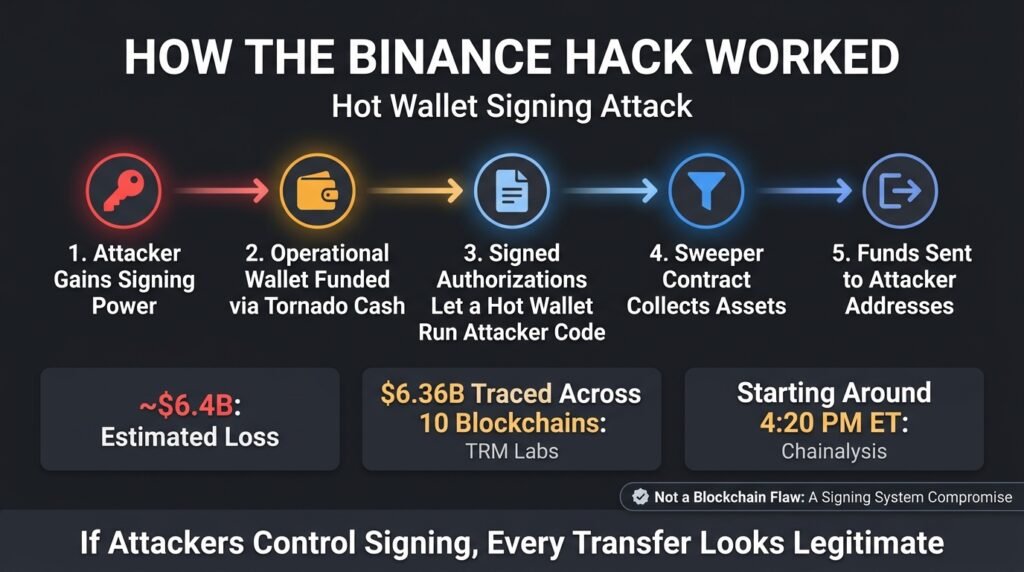
The theft began in the late afternoon of October 29. Chainalysis reported that funds started leaving Binance hot wallets around 4:20 p.m. Eastern Time across multiple blockchains. TRM Labs traced about $6.36 billion in transfers across ten blockchains. Binance confirmed a security incident and suspended withdrawals on several networks. The loss dwarfs every earlier exchange breach. Analysts called it one of the biggest financial crimes of all time, not just in crypto. The investigation continues, and new details emerge every few hours, so readers should follow official updates closely. Binance Hack: Tracing the $6.4 Billion Theft to North Korea – Chainalysis +2
How the Binance Hack Worked
Early evidence points to a compromise of Binance’s signing systems, not a flaw in a blockchain. TRM said that the evidence points to a compromise of Binance’s hot wallet signing infrastructure. Chainalysis described the Ethereum side in detail. The attacker used an operational wallet funded through Tornado Cash to submit valid signed authorizations that let a Binance hot wallet run attacker-deployed code. The attacker then called that wallet and swept its assets into addresses the attacker controlled. On other chains, affected wallets appeared to send funds through ordinary signed transfers. The pattern shows that the attacker held real signing power, not just a stolen password. trmlabschainalysis
The Hot Wallet Signing Problem
Exchanges keep hot wallets online so customers can withdraw quickly. That convenience creates risk, because any system that signs transactions automatically becomes a target. If an attacker takes over the signing process, the blockchain treats every transfer as legitimate. TRM described a sweeper contract that accepts instructions only from the attacker. That design let the thief collect assets quickly and avoid exposing the plan to others. Strong defenses need layered approvals, strict transaction limits, and hardware-based signing controls. Many exchanges still balance speed against safety, and this incident shows how costly that trade can become. trmlabs
Why Analysts Suspect North Korea
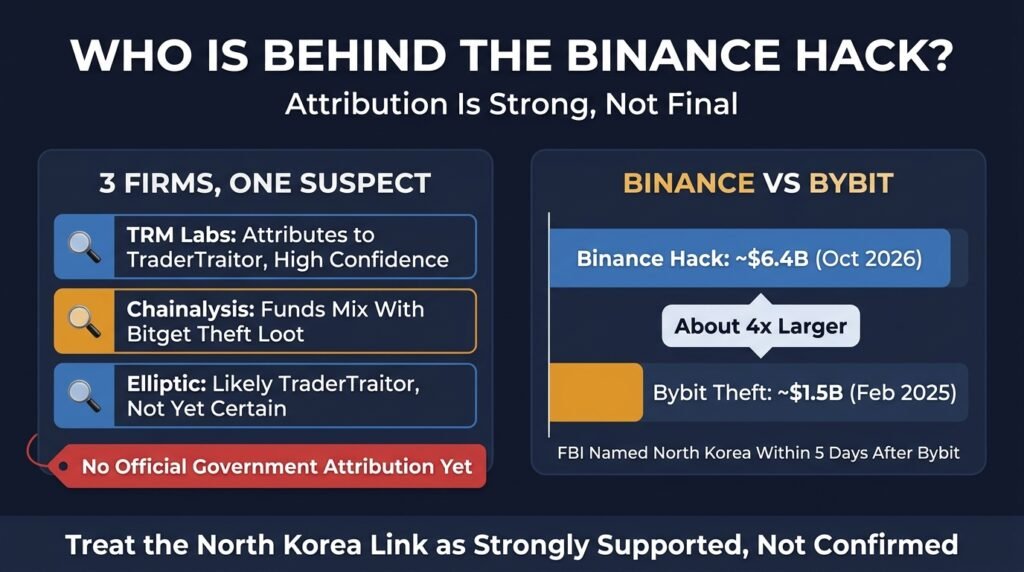
Three analytics firms reached the same conclusion through different evidence. TRM said it attributes the attack to TraderTraitor based on robust on-chain and off-chain intelligence, with high confidence. Chainalysis saw stolen Binance funds commingle on-chain with funds from last month’s Bitget theft, which was attributed to North Korea. Elliptic reached a slightly more cautious view. It said it is likely that TraderTraitor carried out the theft, although the attribution is not yet certain. Elliptic also noted that no official government attribution exists so far. Readers should treat the North Korea link as strongly supported, but not final. Analysts suspect North Korea’s TraderTraitor unit behind Binance hack – ABC News +2.
Who Is TraderTraitor?
TraderTraitor is the name that US authorities use for a North Korean state-linked hacking unit. The FBI used that label in 2025 when it blamed North Korea for the Bybit theft. The bureau said that TraderTraitor actors quickly converted some stolen assets to bitcoin and spread them across thousands of addresses. The group first drew attention years earlier through phishing campaigns that targeted crypto employees. According to the Council on Foreign Relations, attackers sent fake job offers with malicious links that installed TraderTraitor malware. Chainalysis says the group targets exchanges, DeFi protocols, and investors to raise funds for the regime. North Korea was responsible for the $1.5 billion ByBit hack, FBI says +2.
How TraderTraitor Laundered the Stolen Funds
Laundering began within minutes. The attacker knew that stablecoin issuers could freeze funds, so it rushed to swap them for assets nobody can block. Chainalysis reported that the attacker swapped $325 million in stablecoins for $285 million in ETH over nearly 20 minutes. The thief then pushed more stablecoins through stopover wallets to outrun blacklists. Later activity looked automated. Thousands of transactions moved funds in loops, and many addresses first received exactly 1 TRX before forwarding money. Investigators say they have not seen this laundering pattern before. They expect the funds to keep moving in the coming days. Chainalysis
The Race to Freeze Stablecoins
The industry reacted faster than the attacker expected. Chainalysis said that freezes began by 5:14 p.m. Eastern Time, less than an hour after the first transfers. Law enforcement, stablecoin issuers, and analytics firms worked in parallel across several chains. As a result, about $2.8 billion is frozen so far. That amount covers roughly 44% of the loss. Bitcoin and Ether cannot face such freezes, so the attacker kept access to part of the haul. The response still shows a stronger industry network than in earlier hacks. chainalysischainalysis
How the Binance Hack Compares With Bybit
The Bybit theft in February 2025 set the previous record at about $1.5 billion. The Binance hack is roughly four times larger. Both incidents share clear similarities. Elliptic noted that the long preparation, the apparent targeting of staff, and the use of the exchange’s own systems to sign transactions resemble earlier TraderTraitor thefts, including Bybit. Elliptic also linked the laundering services to three other thefts at BigONE, WOO X, and AFX. The FBI named North Korea within five days after Bybit. Analysts now wait to see whether US authorities will move as fast this time. elliptic
Impact of the Binance Hack on Users and Markets
The immediate impact hit withdrawals and confidence. Binance suspended transfers on several networks while it investigated the breach. ABC News reported that Bitcoin and cryptocurrencies issued by World Liberty Financial were among the assets affected. Users now ask how Binance will cover losses and when normal service returns. Anyone with funds on the exchange should read the company’s official statements, because only Binance can confirm what it will do for customers. Traders should also expect higher volatility while the story develops. Check TRM Labs for ongoing tracing updates. abc
Lessons for Exchanges and Traders
This attack proves that even the world’s largest exchange can fall. Exchanges must tighten signing controls, cut hot wallet balances, and monitor every outgoing transfer in real time. Staff training also matters, since North Korean groups often start with social engineering. Traders can reduce their own risk as well. Keep long-term holdings in a hardware wallet that you control, and split funds across several platforms. Enable two-factor authentication and withdrawal whitelists on every account. Stay alert for phishing messages that claim to offer compensation or recovery help. Read more security guides at Scope Bitcoin.
FAQs About the Binance Hack
How much did the Binance hack steal?
Analysts estimate about $6.4 billion, which makes it the largest crypto theft on record.
Who is behind the Binance hack?
TRM Labs and Chainalysis attribute it to North Korea’s TraderTraitor, while Elliptic calls the link likely but not yet certain.
How much stolen crypto has been frozen?
Chainalysis reports that about $2.8 billion is frozen as of its latest update.
Is the Binance hack bigger than the Bybit hack?
Yes. It is about four times larger than the $1.5 billion Bybit theft in 2025.
Are my funds on Binance safe?
Only Binance can answer that. Check its official announcements for the latest status.
Final Thoughts
The Binance hack set a grim record and exposed a weakness in how exchanges protect their signing systems. Analysts link the attack to North Korea’s TraderTraitor, and evidence from several firms supports that view. Fast freezes saved billions, but the attacker still moved a large share of the haul. Watch official statements, follow the tracing updates from Chainalysis, and secure your own assets. This article offers information, not financial advice. For more crypto news, visit Scope Bitcoin.
