


The Polygon future scope has drawn fresh attention as investors look for projects that solve real problems instead of chasing short-term hype. Polygon began as a scaling solution for Ethereum, and it grew into one of the most widely used networks for low-cost transactions. Large brands, payment firms, and asset managers have tested or launched products on it. In 2024, the network also replaced its MATIC token with POL, which marked a major shift in design and long-term strategy. Today, three themes drive the outlook: payments, tokenized real-world assets, and a connected multichain vision for Ethereum scaling. At the same time, Polygon faces strong competition from layer-2 networks, fast layer-1 chains, and stablecoin-focused platforms. This article explains how Polygon works, what supports its growth, which risks matter, and how long-term investors can think about POL. You will also find clear answers to common questions at the end. Read each section carefully before you decide anything.
What Is Polygon (POL)?
Polygon is a blockchain ecosystem built to make Ethereum faster, cheaper, and easier to use. Its founders launched the project in 2017 under the name Matic Network, and they later rebranded it as Polygon. The flagship network, Polygon PoS, runs alongside Ethereum and processes transactions at a tiny fraction of Ethereum’s base-layer cost. Developers can use familiar Ethereum tools, so moving an application to Polygon takes little extra effort. That compatibility helped the network attract thousands of apps in decentralized finance, gaming, and digital collectibles. POL is the native token, and it pays for fees, secures the network through staking, and supports governance. The Polygon team describes a future where many chains share liquidity and security through one connected framework. Anyone can read the official overview on the Polygon website to see the current roadmap. The project also runs community programs and grants to support builders. For more market guides, browse the latest articles on scopebitcoin.com.
From MATIC to POL: Why the Upgrade Matters
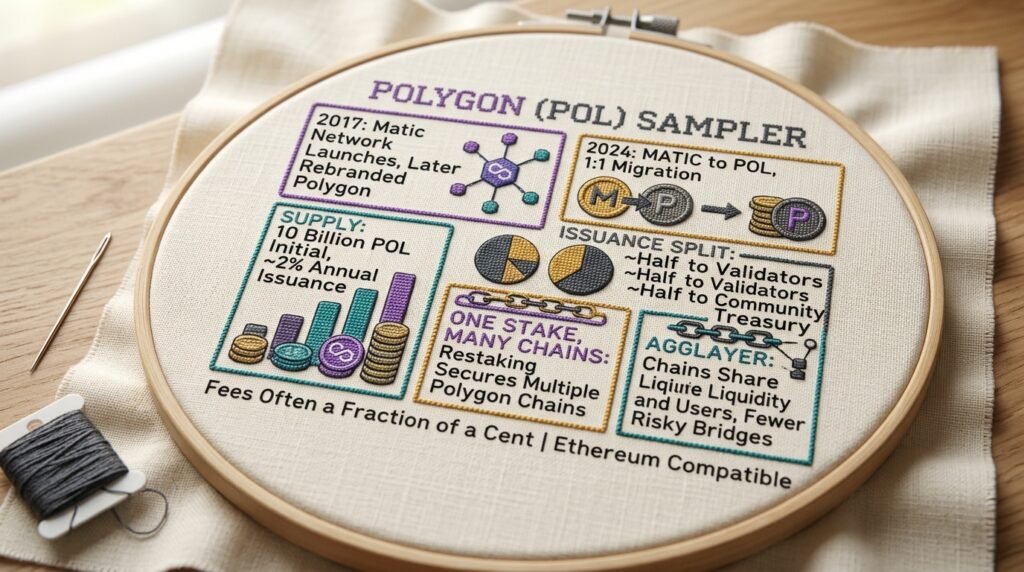
The shift from MATIC to POL changed how the network thinks about its token. Polygon completed the migration in 2024 at a one-to-one ratio, so holders received POL for every MATIC they owned. The new token follows a design that supports many chains instead of a single network. Validators can stake POL and secure multiple Polygon chains at the same time, which can increase the token’s usefulness as the ecosystem grows. This design is often called restaking, and it aims to link demand for POL to the success of the whole ecosystem. The initial supply stands at 10 billion tokens, and the protocol adds new tokens at a set annual rate. A portion of that issuance rewards validators, and another portion funds a community treasury for ecosystem growth. The change also lets the team upgrade the network in a more modular way. Investors should remember that a new token design does not guarantee higher prices. Real adoption must follow, and POL must prove that its broader role creates lasting demand.
POL Tokenomics and Staking
POL’s token model includes a fixed starting supply and a steady annual issuance of about two percent. Roughly half of that issuance rewards validators and stakers, while the other half supports the community treasury. This structure pays for security and also funds grants, tools, and partnerships. Holders can stake POL by delegating to validators, and they earn rewards in return for helping secure the network. Reward rates change over time based on total staked supply and network rules. Staking also carries risks, such as validator penalties, lock-up periods, and smart contract issues in liquid staking products. Inflation adds supply, so price support depends on demand growing faster than new issuance. Analysts compare this design with other proof-of-stake networks to judge whether the rewards and dilution remain balanced. You can check live supply and market data on CoinMarketCap’s POL page. Always verify current staking terms in official wallets before you lock any funds.
Polygon and Ethereum Scaling
Ethereum remains the largest smart contract network, but high fees and congestion pushed many users toward scaling solutions. Polygon stepped into that gap with a network that offers fast confirmations and fees that often cost only a fraction of a cent. This low cost makes small payments, games, and social apps practical for ordinary users. Polygon PoS acts as a sidechain that settles to Ethereum, and the team has also worked on zero-knowledge technology to strengthen security. Zero-knowledge proofs let a network prove that transactions are valid without exposing every detail, and they can improve both speed and trust. The roadmap focuses on higher throughput and quicker finality, so users see transactions settle almost instantly. Ethereum itself keeps improving, and its own layer-2 ecosystem has grown rapidly. That growth brings more competition, but it also confirms the demand for scaling. Polygon’s advantage lies in its brand, its developer base, and its large user count. Investors should track throughput, fees, and active users to see whether that advantage holds.
The AggLayer and Connected Chains
The AggLayer is Polygon’s plan to connect many chains into one smooth experience. Today, moving assets between separate blockchains often requires bridges, which can be slow and risky. The AggLayer aims to let chains share liquidity and users without that friction. A user could interact with several Polygon-connected chains as if they were a single network. This vision matters because it targets one of the biggest weaknesses in crypto: a fragmented market with isolated pools of value. If the design works, developers could launch specialized chains and still reach a shared user base. That would make Polygon a coordination layer for many applications instead of a single competing chain. However, the idea is ambitious, and execution takes time. Competing projects also pursue similar interoperability goals, so Polygon must deliver working products. Investors should follow official updates and adoption numbers before they assume the vision will succeed. A realistic view of progress protects you from overly optimistic expectations.
Payments Use and Real-World Adoption
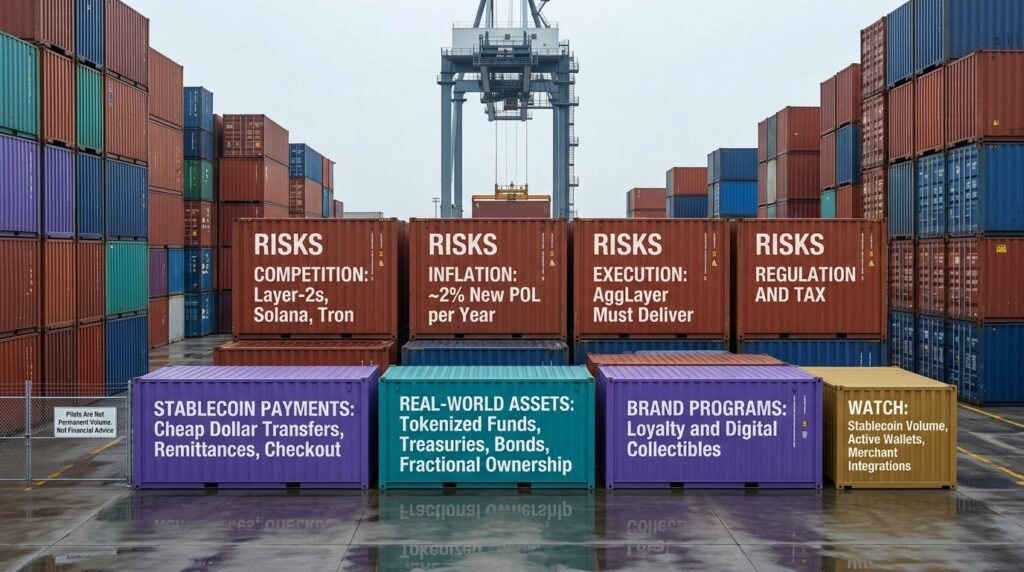
Payments form a key part of the Polygon future scope because low fees and fast settlement suit everyday transfers. Stablecoins already move large volumes on Polygon, and users often choose it for cheap dollar transfers. Payment companies and fintech firms have explored the network for remittances, checkout tools, and settlement. Major brands have also used Polygon for loyalty programs, digital collectibles, and customer engagement, which exposed millions of ordinary users to the network. These examples show that Polygon can handle consumer-scale traffic without extreme costs. The challenge lies in turning pilots into permanent, high-volume products. Many brand experiments faded when market hype cooled, so investors should look for steady payment flows rather than short campaigns. Stablecoin volume, active wallets, and merchant integrations offer better signals than headlines. Competition from Solana, Tron, and several layer-2 networks remains fierce in this area. Polygon must keep fees low and reliability high to defend its share. Sustained payment growth would give POL stronger utility beyond speculation.
Real-World Assets: A Major Growth Opportunity
Real-world asset tokenization means placing traditional assets, such as bonds, funds, or property claims, onto a blockchain. Supporters believe this trend can make markets faster, cheaper, and open around the clock. Polygon has attracted several asset managers and financial firms that tested tokenized funds and treasury products on its network. Its low fees and Ethereum compatibility make it attractive for institutions that want familiar tools. Tokenized assets can settle quickly, and they allow fractional ownership, which opens access to smaller investors. This area could create steady demand for blockspace and strengthen Polygon’s position with serious financial players. Still, the market remains early, and regulation will shape how fast it grows. Many institutions also compare several networks before they choose one, so competition stays intense. Investors should check current tokenized asset totals on public dashboards and watch for new partnerships. Real adoption by regulated firms would be a strong positive signal. Weak growth would suggest that the opportunity needs more time to develop.
Key Risks to Consider Before You Invest
Polygon carries several risks that every investor should weigh against its strengths. Competition tops the list, since Ethereum layer-2 networks, Solana, and other chains fight for the same developers and users. Many applications now launch directly on rival networks, which reduces Polygon’s share of new activity. Execution risk also matters, because ambitious projects like the AggLayer require flawless delivery. Market risk adds pressure, as POL often falls sharply when the wider crypto market weakens. Token inflation creates ongoing dilution, so demand must grow to keep price stable. Security risks exist as well, because bridges, smart contracts, and validator software can contain bugs. Concentration of validators or key infrastructure could raise concerns about decentralization. Brand partnerships can also fade, which weakens the adoption story. None of these risks make POL a poor choice by default, but they call for careful position sizing. Never invest money you cannot afford to lose, and diversify across several assets.
Regulatory and Market Risks
Regulation affects every major crypto asset, and POL is no exception. Authorities in the United States and other regions have debated whether certain tokens count as securities, and Polygon’s token has appeared in some of those discussions. Rules on staking, stablecoins, and tokenized assets could also change how the network operates. Clear regulation could help institutions, while strict rules could limit access or slow adoption. Tax treatment matters too, because swaps, rewards, and transfers can create taxable events in many countries. Market liquidity affects price swings, and thinner order books can magnify moves during stress. Macroeconomic conditions, such as interest rates and risk appetite, often influence crypto prices more than network fundamentals in the short term. Investors should check local laws, exchange policies, and tax duties before they buy or stake. This Polygon future scope analysis cannot replace professional advice, so consult a qualified advisor for your situation. Staying informed helps you avoid avoidable mistakes.
Long-Term Potential: Is Polygon a Good Investment?
Polygon offers a large user base, strong developer tools, and clear exposure to payments and tokenized assets. The move to POL gives the network a flexible token model that can support many connected chains. Ethereum’s growth also helps, since every new user who needs cheaper transactions can become a potential Polygon user. If real-world asset adoption grows, Polygon could capture meaningful institutional activity. On the other hand, the competition remains intense, and the token’s price depends heavily on market cycles. Execution of the multichain vision will decide whether Polygon leads or falls behind. Bulls see a proven infrastructure project with real partners and room to expand. Bears see a crowded market where differentiation grows harder every year. A balanced investor might treat POL as a higher-risk, long-term position inside a diversified portfolio. Dollar-cost averaging and secure storage can reduce timing and custody risks. This article gives information only, not financial advice, so research current data before you act.
FAQs About Polygon Future Scope
What is Polygon used for?
Polygon helps users and developers run fast, low-cost applications connected to Ethereum. People use it for payments, trading, gaming, digital collectibles, and tokenized assets.
What is the difference between MATIC and POL?
POL replaced MATIC as the network’s native token in a one-to-one upgrade. It supports staking across multiple Polygon chains and fits the project’s connected-chain design.
Can you stake POL?
Yes, holders can stake POL by delegating to validators and earn rewards. Rates change over time, and staking may involve lock-up periods and validator risk.
Is Polygon a good long-term investment?
Polygon has strong adoption and a clear roadmap, but it faces tough competition and market risk. Each investor should research current data and match any purchase to personal risk tolerance.
What are the biggest risks of investing in Polygon?
The main risks include competition, execution delays, token inflation, market volatility, and regulatory change. Careful position sizing and safe storage help manage these risks.
Conclusion On Polygon future scope
Polygon remains a major Ethereum scaling network with real users, strong tools, and growing interest from payment firms and asset managers. The POL upgrade, the AggLayer vision, and real-world asset adoption support the long-term case. Competition, execution risk, and regulation still demand discipline and careful planning. This Polygon future scope review suggests that POL suits patient investors who follow adoption data and manage risk wisely. Do your own research, diversify your holdings, and rely on official sources for current data. For more info on Polygon future scope, visit scopebitcoin.com
