


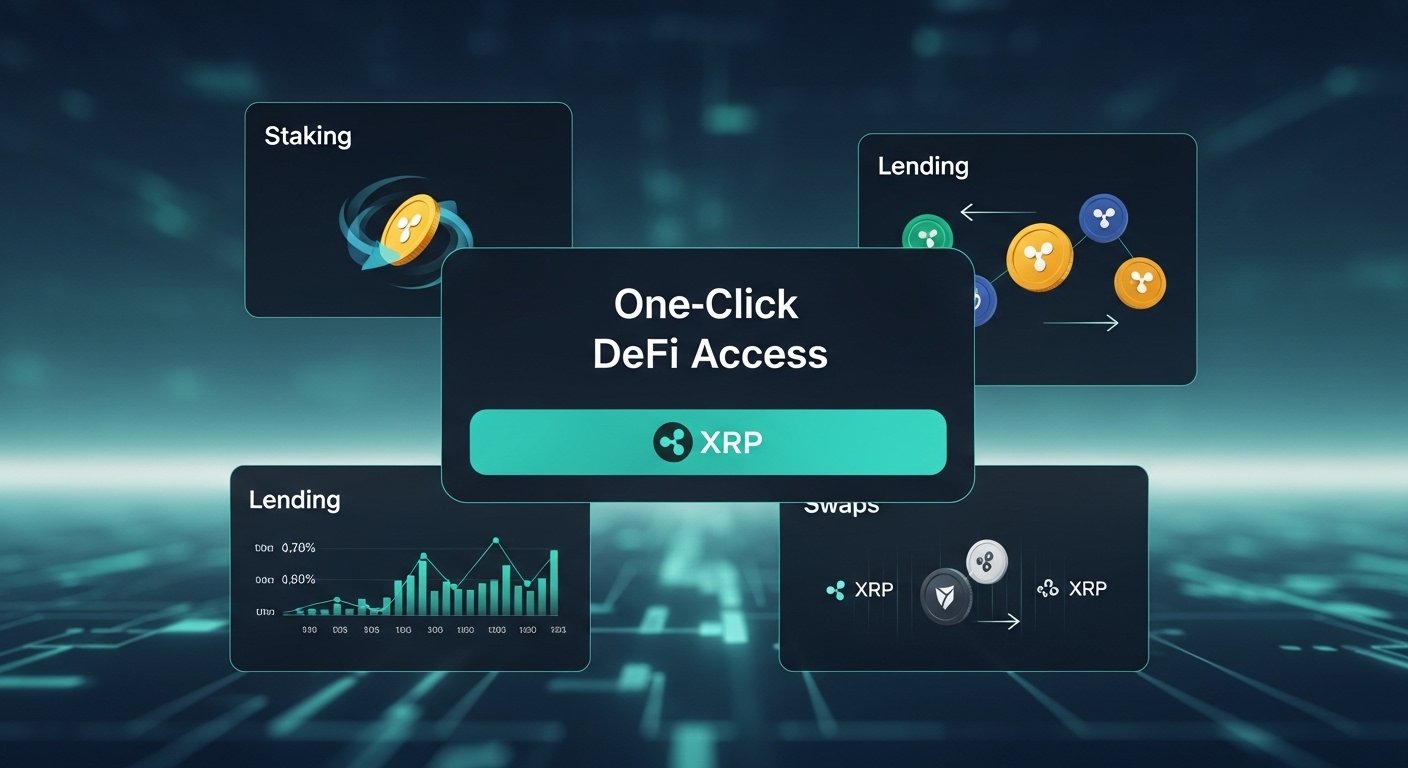
XRP has long been one of the most widely held digital assets in the market, yet many XRP holders have historically found it harder to access decentralized finance compared to users on smart-contract-native networks. DeFi thrives on composability—apps talking to apps, assets moving into pools and vaults, and strategies compounding yield automatically. But because the XRP Ledger wasn’t designed around the same style of EVM smart contracts as Ethereum-like ecosystems, XRP holders often had to jump through extra hoops to participate in DeFi. Those hoops included learning bridges, juggling networks, dealing with confusing token formats, and signing multiple transactions across unfamiliar interfaces.
That is where the collaboration between Flare and Xaman becomes important. The promise behind this integration is not simply “more DeFi,” but a much cleaner on-ramp: one-click DeFi access for XRP holders. Instead of requiring several steps to move from holding XRP to earning potential yield, the goal is to compress the experience into a single, guided action inside a familiar wallet environment. This shift aims to unlock meaningful dormant liquidity—often described as over 2 billion XRP tokens sitting idle in wallets—by making DeFi participation feel more like a normal wallet feature rather than a complex technical process.
This matters for two reasons. First, it offers XRP holders a new way to deploy capital while remaining aligned with self-custody and on-chain transparency. Second, it can expand the overall DeFi footprint of XRP by making participation simpler and more attractive to the average user, not just experienced DeFi traders. In a market where ease-of-use often determines what scales, one-click DeFi access could be the UX breakthrough that helps accelerate XRP DeFi and push XRPFi into a more mainstream phase.
Why Flare and Xaman Fit Together
Flare and Xaman are not doing the same job. They are solving different parts of the DeFi access problem, and their overlap is exactly what makes one-click DeFi access for XRP realistic.
Flare’s Role: Bringing Smart-Contract Utility to XRP
Flare is designed to be a smart-contract network where assets from other ecosystems can be represented and used inside DeFi applications. The key value of Flare in this context is that it provides a place where DeFi strategies can run: vaults, liquidity pools, automated yield routing, and other decentralized finance primitives that require programmability. If XRP holders want access to DeFi-style earning strategies without abandoning XRP exposure, the asset needs a reliable way to be used in that programmable environment.
This is where the concept of an XRP representation comes in. In Flare’s ecosystem, XRP can be turned into an on-chain representation used in DeFi. This representation is commonly discussed as FXRP in relation to the broader FAssets design. For users, the deep mechanics should be abstracted behind the interface, but the outcome is what matters: XRP becomes usable in DeFi vaults, lending markets, and liquidity systems without requiring the user to manually rebuild their entire workflow.
Xaman’s Role: A Familiar Self-Custody Gateway for XRP Holders
Xaman’s power lies in user trust, daily usage, and a wallet experience that already feels native to the XRP community. Many XRP holders do not want to move into unfamiliar DeFi wallets or experiment with complicated multi-chain setups. They want a smooth, intuitive experience that keeps them in control of their keys. Xaman serves as that self-custody anchor.
By embedding DeFi entry points into a wallet that XRP holders already understand, the integration can make one-click DeFi access feel safe and routine. Instead of telling users to “learn DeFi,” the wallet becomes the guide. This matters because most adoption barriers are not philosophical; they are practical. Users avoid DeFi because it feels complicated. Wallet-native DeFi design changes that equation.
Why “2 Billion XRP Tokens” Is Such a Big Signal
The headline idea—unlocking DeFi access for over 2 billion XRP tokens—matters because it frames the potential liquidity impact. Crypto markets are not just driven by price action; they are driven by liquidity behavior. Idle tokens do not deepen pools, do not generate fees, and do not support lending markets. When large pools of dormant assets begin flowing into DeFi, entire ecosystems can shift.
If even a small share of idle XRP moves into DeFi vaults, liquidity pools, or yield strategies, it can create a compounding effect: more liquidity can reduce slippage, increase trading activity, increase protocol revenue, and attract more builders. Builders create more opportunities, which attracts more users, and the cycle can reinforce itself. This is one reason the phrase one-click DeFi access is so powerful. It is not only about convenience; it is a liquidity activation lever.
The XRP community is large, but many holders historically have not participated in DeFi due to friction. A reduction in friction—especially when paired with a strong wallet experience—can unlock new behavior. That behavior is what transforms a narrative from “XRP is held” to “XRP is deployed,” which is the foundation of XRPFi.
What One-Click DeFi Access Actually Means
The phrase one-click DeFi access is easy to misunderstand. It does not mean DeFi becomes magically risk-free or that no underlying steps occur. It means the user experience is compressed: the wallet handles the complexity behind the scenes so the user can execute a single action rather than manage a multi-step process.
From Multi-Step Bridging to a Single Guided Action
Traditionally, an XRP holder wanting DeFi exposure might need to:
move assets, bridge to another chain, acquire gas tokens, connect to a dApp, approve contracts, and then deposit into a strategy. Even one missing step can result in confusion or failure.
In a one-click model, the user instead selects an option (such as a vault), confirms details, and signs. The design intent is that the user interacts with a familiar wallet flow, while the system routes assets properly into the DeFi destination on Flare.
Vaults as the “DeFi Product Layer”
Vaults are often used in DeFi to simplify decision-making. Instead of requiring users to choose among dozens of pools and manage rebalancing, a vault packages a strategy into something understandable: deposit, earn, withdraw. In the context of one-click DeFi access, vaults can serve as the product layer that gives XRP holders an approachable path into DeFi. A vault can be designed with specific risk parameters, diversified routes, or yield sources. The vault may handle strategy moves that users would otherwise have to do manually. That is why vault-based onboarding can be such a strong match for new DeFi participants.
How XRP Stays at the Center of the Experience
One psychological advantage of this approach is that users are not being pushed to abandon XRP. They are being offered a way to use XRP in DeFi while keeping the concept of “I’m deploying my XRP tokens” intact. When UX is framed around using XRP rather than swapping away from it, it becomes easier for long-term holders to participate without feeling like they are leaving their asset thesis behind.
The Rise of XRPFi: Turning XRP Into DeFi Capital
XRPFi is a growing idea: using XRP as productive capital within DeFi environments. Historically, most DeFi growth happened around assets that were native to smart-contract ecosystems. But cross-chain design has changed what is possible. When XRP can be represented in a DeFi environment and easily deposited through a wallet integration, XRPFi becomes more accessible.
Why XRPFi Needs Better UX to Scale
DeFi is full of innovation, but it is also full of complexity. The next stage of growth is not just new protocols—it is better product design. Wallet-level DeFi integration is one of the most practical ways to do that. The more DeFi feels like a built-in feature, the faster the learning curve collapses. If XRPFi wants to become a major category, it needs the same thing every financial product needs: simple onboarding and clarity. One-click DeFi access is essentially an attempt to bring consumer-grade usability to a traditionally technical arena.
Liquidity, Incentives, and Ecosystem Expansion
When more XRP tokens enter DeFi, there are ripple effects. Liquidity pools become deeper. Trading becomes more efficient. Lending markets have more capacity. Protocols can offer new products. The ecosystem becomes more attractive to developers, and a richer ecosystem creates more demand for DeFi participation. The long-term impact is not just about yield for users. It’s about creating a self-reinforcing environment where XRP-based DeFi becomes a real market segment with sufficient liquidity and product diversity.
Cross-chain DeFi and Wallet-Native Onboarding
The integration reflects a broader trend: users want cross-chain DeFi without the pain of managing cross-chain tools. Wallet-native onboarding solves that by bringing the cross-chain steps behind a clean interface. This is not just a convenience feature; it is a necessary step for mainstream adoption.
DeFi vaults and Simplified Yield Strategies
Vaults offer structure. For the average user, vaults are easier than manual yield farming. When vaults are combined with one-click DeFi access, the outcome is a product that feels closer to traditional finance: deposit and earn, without a constant need to manage positions.
Self-custody wallets and Safer Participation
DeFi adoption grows when users feel safe. Self-custody wallets are important because they keep control in the hands of the user. When DeFi access happens inside a self-custody environment like Xaman, the experience becomes more aligned with the values of decentralized finance.
Risks and Realities: What One-Click DeFi Access Does Not Solve
It’s important to keep expectations grounded. One-click DeFi access improves usability, but it does not eliminate underlying risks.
Smart Contract Risk Still Exists
Any DeFi vault relies on smart contracts. Smart contracts can fail due to bugs, exploits, or unexpected interactions. Even well-reviewed systems can be attacked. A smooth interface can make DeFi feel safe, but the risk profile still depends on the robustness of the protocols involved.
Yield Is Variable, Not Guaranteed
Yield changes with market conditions. Vault returns can fluctuate based on fees, incentives, liquidity utilization, and broader volatility. Users should treat yield projections as dynamic rather than fixed. The value of one-click DeFi access is convenience and accessibility, not a guarantee of returns.
Representation and System Complexity Still Matters
Even if the interface hides complexity, the underlying system includes additional components compared to simply holding XRP on the XRP Ledger. Users should understand that vault participation involves interacting with a DeFi environment that may use representations of assets and protocol mechanisms that behave differently than native XRP holding.
What This Means for XRP Holders and DeFi Adoption
For everyday XRP holders, this shift can be meaningful in very practical ways.
A More Natural Way to Explore DeFi
Instead of going from “I hold XRP” to “I need to learn a new chain,” the user can go from holding to depositing through a familiar wallet experience. That reduces hesitation. DeFi is often intimidating, but a wallet-guided flow can make it approachable.
More Choice Without Overload
When DeFi options are curated—especially through vaults—users can explore without needing to become experts. The user is not forced to understand every pool and protocol detail just to start. That is a big deal for onboarding.
A Step Toward Making XRP Productive Capital
If more XRP holders begin deploying their tokens, the market’s understanding of XRP utility may expand. XRP becomes not only an asset people hold or transfer, but also an asset that can be deployed in decentralized finance strategies through one-click DeFi access.
The Future Outlook: Where This Could Go Next
The success of this approach depends on execution: vault design, transparency, security, performance, and ongoing improvements to UX. As DeFi becomes more consumer-oriented, the best products will be those that combine clarity with power. If Flare and Xaman continue to refine the experience, expand vault options, and improve transparency around risks and returns, one-click DeFi access could be the kind of innovation that helps XRPFi scale. The broader implication is that crypto’s next growth wave is likely to be won at the interface layer. Chains and protocols matter, but users interact with wallets. If wallets become the gateway to simplified DeFi, then the ecosystems that integrate best will have an advantage.
Conclusion
Flare and Xaman enabling one-click DeFi access for 2 billion XRP tokens represents a strategic attempt to transform dormant XRP holdings into active DeFi capital. By pairing Flare’s smart-contract DeFi environment with Xaman’s familiar self-custody wallet experience, XRP holders gain a more approachable path into XRP DeFi and XRPFi. The biggest value is not only potential yield, but usability. When users can move from holding XRP to depositing into DeFi vaults with a streamlined flow, adoption becomes more likely. While risks remain—smart contract vulnerabilities, yield volatility, and system complexity—this integration can still mark a major step toward making DeFi feel normal for everyday XRP holders. If executed well and expanded responsibly, one-click DeFi access could become a defining UX moment for XRP in decentralized finance.
FAQs
Q: What is one-click DeFi access for XRP?
One-click DeFi access for XRP is a simplified wallet experience where an XRP holder can enter DeFi vault strategies through a single guided action instead of multiple steps like bridging, approvals, and external dApp navigation.
Q: Do I need advanced DeFi knowledge to use one-click DeFi access?
The goal is to reduce the need for advanced knowledge by presenting curated vault options and a straightforward deposit flow, making DeFi participation more approachable for everyday users.
Q: Does one-click DeFi access mean my XRP stays as XRP?
From a user perspective, the intent is to keep XRP at the center of the experience. Under the hood, DeFi may use representations to enable smart-contract interactions, but the product is designed to feel like you are deploying XRP.
Q: Is one-click DeFi access safe?
It can be safer from a usability standpoint because it reduces user-error risk and confusing steps, but DeFi still includes smart contract risk and market risk. Users should always review vault details and understand volatility.
Q: Why is the “2 billion XRP tokens” idea important?
It highlights the scale of idle XRP that could potentially move into DeFi. If even a portion of dormant XRP is deployed through one-click DeFi access, it can deepen liquidity, improve ecosystem activity, and accelerate XRPFi growth.
