


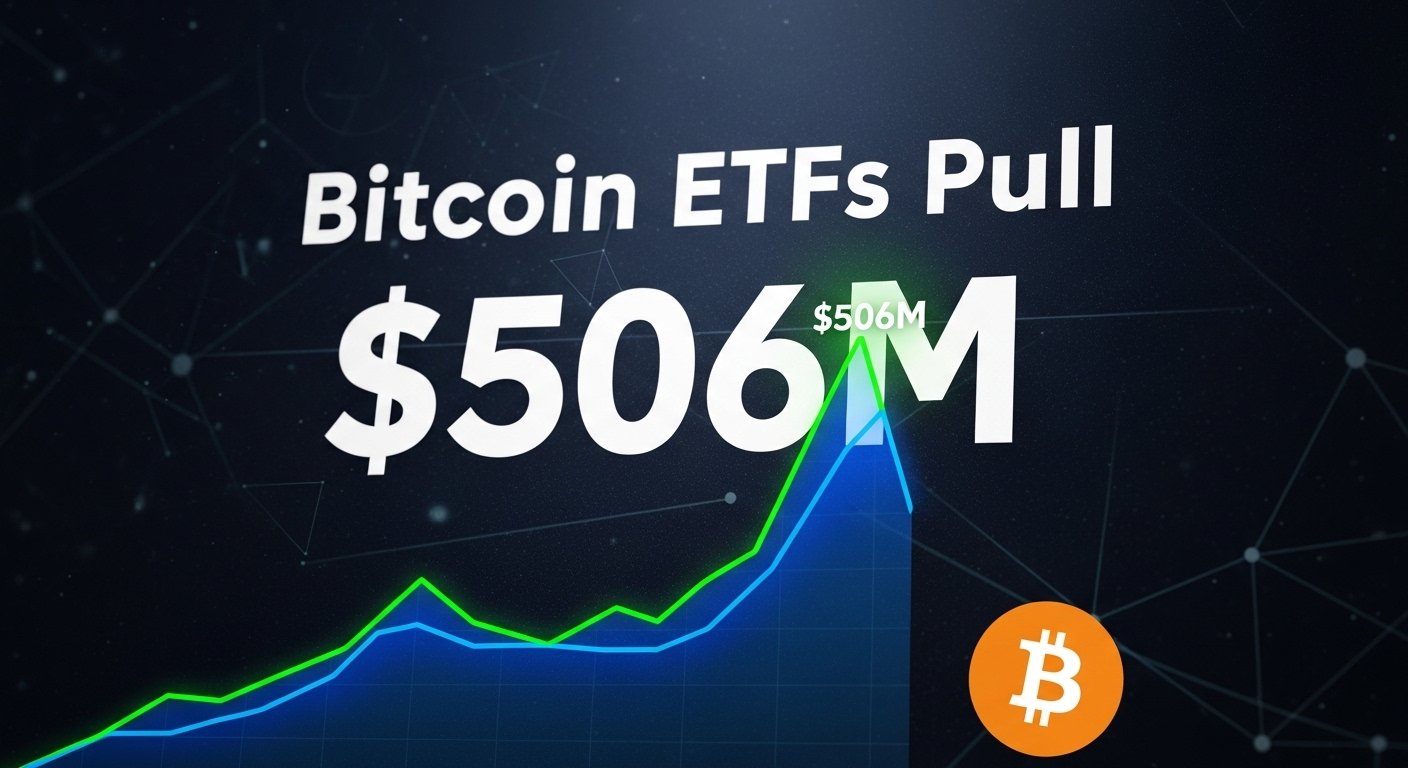
Bitcoin rarely moves on a single factor, but every so often, two powerful forces line up at the same time: demand strengthens while supply pressure relaxes. That combination is exactly what the market is digesting after Bitcoin ETFs posted $506 million in net inflows in a single session, right as signs emerged that selling pressure is cooling. For anyone watching the tug-of-war between buyers and sellers, this pairing matters because it hints at a shift in momentum—one driven not only by price speculation but also by measurable capital movement.
A big inflow day for Bitcoin ETFs suggests that investors, particularly those who prefer regulated and familiar investment rails, are stepping in with fresh allocations. At the same time, “selling pressure easing” implies fewer coins are being pushed onto the market aggressively—whether through panic selling, exchange-driven distribution, or leveraged liquidations. When inflows and easing sell pressure arrive together, Bitcoin doesn’t need extraordinary buying to move higher; it simply needs steady demand to meet a calmer supply side.
Still, no single day tells the entire story. The crypto market can turn quickly, and ETF flows can reverse just as fast as they surge. The real value of this moment is what it reveals about market structure: spot Bitcoin ETF demand appears to be reawakening, while short-term sell-side heat looks reduced. In this article, we’ll unpack what the $506M inflow could mean, how institutional demand differs from retail momentum, why market liquidity and leverage matter, and what to watch next if you’re tracking Bitcoin ETFs for signals about Bitcoin’s direction.
Understanding the $506M Inflow: Why Bitcoin ETFs Matter
The rise of Bitcoin ETFs changed how many investors access Bitcoin. Instead of buying directly on an exchange, managing custody, or handling wallet security, investors can gain exposure through an ETF that trades like a traditional stock. This structural shift brought new pools of capital into the market—capital that often moves differently than typical crypto trading flows.
A $506M inflow is meaningful not only because it’s a large number, but because it’s capital choosing a specific route into Bitcoin exposure. That route tends to be preferred by investors who value compliance, brokerage access, and operational simplicity. When these investors show up in size, it often reflects improving confidence in the near-term risk environment or a strategic move to add exposure at perceived attractive levels.
Inflow data also matters because it can reflect demand that is not purely speculative. While some participants may trade Bitcoin ETFs tactically, many holders use ETFs as medium- to long-term portfolio positions. That means a surge in inflows can represent stickier capital—capital that is less likely to panic sell on the first dip, compared to high-leverage derivatives traders.
How spot Bitcoin ETF inflows can influence price
A spot Bitcoin ETF is designed to track the price of Bitcoin by holding Bitcoin (directly or through approved custody mechanisms). When net inflows occur, the ETF ecosystem typically creates new shares, and the underlying exposure is adjusted to match investor demand. In a simplified sense, more inflows can lead to more spot buying in the background, which can tighten supply conditions.
This doesn’t mean inflows automatically push Bitcoin up every time. Price is still driven by broader market forces—macro sentiment, liquidity conditions, risk appetite, and crypto-specific catalysts. But persistent inflows can tilt the balance toward buyers, especially when sell pressure is already easing.
Why one day of inflows can still be a big signal
Markets trade on marginal changes, and the margin often determines direction. A single strong inflow day can signal that buyers are no longer waiting on the sidelines. It can also mark a turning point in sentiment after a period of hesitation. While one day doesn’t guarantee a trend, it can be the first clear clue that the demand engine behind Bitcoin ETFs is switching back on.
What “Selling Pressure Eases” Really Means
Selling pressure is the force that keeps markets pinned down even when buyers appear. In Bitcoin, that pressure can come from multiple sources: exchange deposit spikes, short-term holders locking in profits, miners selling to cover operating costs, macro-driven risk-off moves, or leveraged traders getting liquidated.
When selling pressure eases, it often means the market is no longer absorbing relentless supply at market price. It can also mean that sellers are becoming less urgent—selling slows, and buyers don’t have to fight as hard to stabilize price. This is why easing sell pressure can make ETF inflows feel more powerful: inflows don’t have to overcome a flood of supply; they only need to meet a steadier stream.
The role of exchange behavior and supply dynamics
A common way analysts interpret sell pressure is by watching how much Bitcoin appears to be moving toward exchanges, where coins are more likely to be sold. When exchange-bound flows decline, it can suggest reduced intent to sell in the short term. It doesn’t mean long-term holders will never sell again, but it suggests that immediate distribution is less intense. When this lines up with higher ETF inflows, it can create a favorable short-term setup. Demand strengthens through Bitcoin ETFs, while supply becomes less aggressive—so price can respond faster to incremental buying.
Leverage and forced selling: the hidden accelerant
Bitcoin’s sharp drops are often fueled by leverage. When too many traders pile into leveraged positions, a relatively small price drop can trigger liquidations. Those liquidations become market sells, which can push price lower, triggering more liquidations in a cascade. If selling pressure is easing, it can indicate that this liquidation-driven selling is less dominant. A calmer leverage environment often supports more sustainable price action. In that context, Bitcoin ETFs inflows can help support upward drift rather than simply being absorbed by forced selling events.
Why Bitcoin ETF Demand Is Rising Again
The return of strong inflows tends to have multiple drivers rather than one. Sometimes it’s a shift in macro mood, sometimes it’s technical positioning, and sometimes it’s a simple rotation back into risk assets after a period of caution. One of the most important reasons Bitcoin ETFs can see inflows as selling pressure eases is psychological: investors become more willing to buy when downside volatility appears to be cooling. When the market feels less fragile, the perceived cost of entering a position decreases.
Institutional demand and the comfort of regulated exposure
Institutional demand often prefers vehicles that fit into existing systems. ETFs sit neatly inside brokerage accounts, retirement wrappers, and advisor platforms. This is why Bitcoin ETFs are seen as a gateway for larger pools of capital. If a wave of investors decides Bitcoin is attractive at current levels, spot Bitcoin ETF allocations can become the fastest and simplest path. This doesn’t mean only institutions buy ETFs, but the structure tends to align with institutional workflows. When you see large inflows, it can suggest that bigger, more compliance-oriented capital is participating again.
Portfolio positioning and rebalancing effects
Another factor is portfolio mechanics. Investors who reduced risk exposure during volatile periods may begin re-adding it as conditions improve. A strong inflow day can reflect rebalancing, where Bitcoin exposure is increased back toward target allocations. In that sense, inflows can be a sign that Bitcoin is being treated as a core portfolio component rather than a purely speculative trade.
The Feedback Loop: How Bitcoin ETFs and Sentiment Reinforce Each Other
Bitcoin’s market narratives often create feedback loops. Positive ETF inflows can attract attention, which can improve sentiment, which can encourage additional inflows. Conversely, outflows can create negative feedback loops. That’s why inflow headlines matter: they don’t just reflect investor behavior—they can shape it. When people see sustained inflows into Bitcoin ETFs, many interpret it as confirmation that smart money is accumulating. Even if that’s not always accurate, the perception can influence behavior across the market. Traders may become more comfortable buying dips, long-term investors may feel validated, and sidelined capital may begin to deploy.
Why steady inflows matter more than spikes
Spikes are exciting, but steady inflows are more meaningful. A single $506M day is a powerful signal, but if inflows fade immediately, the market may treat it as a one-off. If inflows continue for multiple sessions, it supports the narrative that demand is rebuilding in a sustained way. This is why professional observers watch not only the size of inflows, but the pattern. Consistency is the difference between a headline and a trend.
Market liquidity and the ability of inflows to move price
Market liquidity determines how strongly inflows translate into price movement. In high-liquidity environments, even large inflows can be absorbed with minimal price disruption. In lower-liquidity environments, inflows can push price higher faster. Bitcoin’s liquidity varies by venue and time. When selling pressure eases, liquidity can improve because the market isn’t being hit by urgent sell orders. In that calmer environment, Bitcoin ETFs inflows can have a clearer path to influencing price.
Comparing Bitcoin ETFs to Other Demand Signals
Bitcoin ETFs are one of the cleanest demand signals because they represent observable net capital movement into a specific product. But they’re not the only signal worth watching. The best approach is to compare ETF flows with other indicators of demand and supply.
Spot market activity versus ETF flows
Spot market activity includes direct buying and selling on exchanges. It can reflect retail behavior more strongly, though institutions also trade spot. ETF flows, by contrast, reflect demand through regulated wrappers. If both spot demand and Bitcoin ETF inflows are rising together, that alignment is bullish. If ETF inflows rise but spot market demand remains weak, the impact may be slower.
On-chain behavior and holder psychology
On-chain data can hint at holder intent. When coins move from long-term storage to exchanges, it can signal distribution. When coins move into long-term custody patterns, it can signal accumulation. If on-chain signals suggest reduced selling while ETF inflows increase, the demand-supply balance may be improving. This doesn’t guarantee upside, but it improves the probability that the market can absorb normal selling without breaking down.
What Could Go Wrong: Risks Even When Selling Pressure Eases
Crypto markets are famous for punishing overconfidence. Even with strong inflows and easing sell pressure, risk remains. Bitcoin can still react sharply to macro shocks, regulatory headlines, exchange events, or sudden shifts in risk appetite.
Flows can reverse fast
Bitcoin ETFs are liquid, and investors can exit quickly if sentiment changes. That means inflows can become outflows without much warning. If inflows reverse while selling pressure returns, price can weaken quickly.
The market can misread “easing selling pressure”
Selling pressure easing doesn’t mean sellers are gone. It means they’re quieter right now. Profit-taking can return when price rises, and larger holders can distribute into strength. A healthy market often includes selling—what matters is whether demand can absorb it without collapsing.
Overheating can return through leverage
Even if leverage is calmer today, it can rebuild rapidly during a rally. If traders chase price with high leverage, the market can become fragile again. In that scenario, even continued Bitcoin ETFs inflows might not prevent sharp pullbacks.
What to Watch Next: The Most Important Signals
If you want to track this story intelligently, focus on confirmation rather than excitement. The goal is to determine whether the $506M inflow day is the start of a broader trend or simply a temporary burst.
Whether Bitcoin ETF inflows remain consistently positive
The first signal is the simplest: do Bitcoin ETFs continue to record net inflows over the coming sessions? Consistent inflows suggest sustained allocation. Mixed flows suggest uncertainty. Persistent outflows suggest risk-off conditions returning.
Whether price holds key levels without heavy selling
A classic sign of easing selling pressure is when Bitcoin can hold or reclaim levels without immediately getting slammed back down. If price stabilizes and gradually trends higher, it suggests sellers are not overwhelming buyers.
Whether volatility stays controlled
Controlled volatility is often a sign of healthier market structure. If volatility spikes sharply, especially on small news events, it can indicate that the market remains fragile and selling pressure could return.
Conclusion
The headline “Bitcoin ETFs Pull $506M in Inflows as Selling Pressure Eases” captures a meaningful moment because it reflects two shifts happening together: stronger demand through Bitcoin ETFs and a calmer sell-side environment. A $506 million inflow day is not just a number—it’s evidence that capital is flowing back into regulated Bitcoin exposure at a time when the market appears less burdened by aggressive selling and forced liquidation dynamics.
That said, the most important part of this story is what happens next. If Bitcoin ETFs continue to attract steady ETF inflows and Bitcoin holds its ground without renewed sell pressure, the market could be setting up for a more sustainable advance. If inflows fade or reverse, or if leverage rebuilds too quickly, the relief may be temporary. In Bitcoin, trends are confirmed by persistence, not by single-session headlines. The smart approach is to watch the pattern, not just the spike.
FAQs
Q: What are Bitcoin ETFs, and why do inflows matter?
Bitcoin ETFs are exchange-traded funds that give investors Bitcoin exposure through traditional brokerage accounts. Inflows matter because they show net new capital entering the product, which can reflect stronger demand and improved sentiment.
Q: Does $506M in Bitcoin ETF inflows guarantee Bitcoin will go up?
No. A large inflow day can support price, but Bitcoin is influenced by macro conditions, liquidity, leverage, and broader market sentiment. Inflows are a signal, not a guarantee.
Q: What does “selling pressure easing” indicate for Bitcoin?
It generally suggests fewer urgent sellers and reduced forced selling. When sell pressure eases, Bitcoin can respond more positively to steady demand, including demand expressed through spot Bitcoin ETF inflows.
Q: Are Bitcoin ETF buyers mostly institutions?
Not exclusively, but Bitcoin ETFs tend to attract more institution-friendly capital because they fit regulated frameworks and traditional portfolio systems. That’s why ETF flows are often viewed as a proxy for institutional demand.
Q: What should I track after a big Bitcoin ETF inflow day?
Watch whether Bitcoin ETFs continue to post consistent inflows, whether Bitcoin holds support levels without heavy selling, and whether leverage-driven volatility stays controlled. Consistency is the key confirmation signal.
