



Crypto markets don’t move on charts alone. They move on stories, liquidity, and the invisible currents of macro policy. That’s why the claim that Arthur Hayes says Iran conflict could trigger Fed easing, boost Bitcoin has captured attention across both traditional finance and digital asset circles. It’s not just a geopolitical headline. It’s a theory about how the world’s most powerful central bank reacts when global stress collides with domestic economic pressure.
Arthur Hayes has built a reputation for tying Bitcoin’s price action to the “plumbing” of the financial system: interest rates, risk appetite, the strength of the dollar, and—most importantly—how easy it is for capital to move into speculative and growth-oriented assets. In his view, major geopolitical flashpoints can accelerate policy shifts. When the stakes rise, governments spend more, markets wobble, and the demand for stability often pushes policymakers toward looser conditions. This is the central idea behind the phrase Arthur Hayes says Iran conflict could trigger Fed easing, boost Bitcoin: the conflict is the spark, and liquidity is the fuel.
But it’s essential to approach this responsibly. A conflict-driven thesis is never a simple “buy because war.” The market’s first reaction to escalating risk can be violent, messy, and risk-off. Bitcoin can drop sharply before it rallies. Hayes’ framework focuses on the second phase: what happens after the initial shock, when policymakers and financial institutions move to prevent a deeper downturn. If that response involves Fed easing, a softer interest-rate environment, and improved global liquidity, Bitcoin often benefits. In this deep-dive, you’ll learn how the argument works, why it appeals to macro-minded investors, what could invalidate it, and how to track the signals that matter—without getting trapped by hype or overconfidence.
From Iran Conflict to Fed Easing
The phrase Arthur Hayes says Iran conflict could trigger Fed easing, boost Bitcoin compresses several complex relationships into one headline. To make sense of it, you need to separate the idea into three layers: the geopolitical catalyst, the economic transmission, and the Bitcoin response.
The Geopolitical Catalyst: Why Iran Matters to Markets
Iran sits at the center of a region with outsized importance to energy markets and global trade routes. Even a modest rise in perceived risk can lift the “risk premium” priced into oil and shipping, and that can ripple through inflation expectations, consumer sentiment, and corporate costs. Markets fear not only what happens today, but what might happen next—especially when uncertainty is high and information is incomplete. In this setting, investors often reduce exposure to risk assets first. That initial reaction can hurt equities and crypto. Yet Hayes’ thesis isn’t about the first move. It’s about what policymakers do when the first move threatens to become a sustained slump.
The Economic Transmission: Why Conflict Can Pressure the Fed
The Federal Reserve doesn’t set policy based on geopolitics directly. It reacts to economic conditions: inflation, employment, financial stability, and the broader health of markets. A conflict becomes relevant if it changes those conditions meaningfully. An Iran conflict can pressure the Fed through multiple pathways. First, higher energy prices can squeeze consumers and businesses, slowing growth. Second, market volatility can tighten financial conditions, making credit harder to obtain and risk-taking less attractive.
Third, the broader uncertainty can reduce investment and business confidence. If these forces intensify, the Fed may face a choice: maintain a restrictive stance to fight inflation, or pivot toward easing to cushion growth and stabilize markets. This is the logic behind the claim that Arthur Hayes says Iran conflict could trigger Fed easing, boost Bitcoin. The conflict isn’t the policy decision. The conflict is the catalyst that can raise the probability of a policy shift.
The Bitcoin Response: Why Easing Can Boost Bitcoin
Bitcoin is unusually sensitive to liquidity. When money becomes cheaper and more available, investors tend to look for assets with high upside potential, strong narratives, and global accessibility. Bitcoin checks all three boxes. Lower rates can also reduce the appeal of cash and certain yield instruments, making scarce assets more attractive in relative terms. So if an Iran conflict increases the chance of Fed easing, that shift in expectations alone can boost Bitcoin—sometimes even before any policy change actually occurs.
Why Arthur Hayes Connects War, Liquidity, and Bitcoin
Arthur Hayes’ worldview is shaped by a simple principle: markets are ultimately driven by liquidity. When dollars are plentiful and borrowing conditions are easy, risk assets rise. When liquidity tightens, risk assets struggle.
Hayes’ Macro Lens: Liquidity as the Primary Driver
In Hayes’ framework, the most important question is not “What is the CPI print?” or “What did the Fed chair say?” The question is “Is liquidity expanding or contracting?” That includes policy rates, but it also includes the broader system: funding markets, bank lending conditions, the ease of refinancing, and the appetite of investors to deploy leverage. This is why the line Arthur Hayes says Iran conflict could trigger Fed easing, boost Bitcoin resonates. It’s consistent with a liquidity-first perspective. If the conflict leads to a more accommodative stance—directly or indirectly—Bitcoin becomes a likely beneficiary.
The Role of Fiscal Pressure and Market Stability
Large-scale geopolitical episodes can increase government spending and widen fiscal deficits. While the Fed is independent, it operates in an ecosystem where financial stability matters. If markets begin to seize up or credit stress spreads, central banks often shift from tightening to stabilizing. That stabilization can come through communication, liquidity facilities, or eventually through rate cuts. Hayes’ argument is essentially that severe or prolonged conflict raises the odds of stabilization policies, and those policies can be bullish for Bitcoin.
The Fed’s Dilemma: Inflation vs. Growth During a Conflict
A crucial nuance is that an Iran conflict can push inflation and hurt growth at the same time, largely through energy prices. This creates a dilemma for policymakers.
When Oil Rises, Inflation Can Re-Accelerate
If energy prices surge, headline inflation can rise quickly. That can make it harder for the Fed to justify immediate easing, especially if inflation expectations start to climb. In a purely inflation-driven world, the Fed might stay tighter for longer.
When Households Get Squeezed, Growth Can Crack
Higher energy costs act like a tax on consumers. They reduce discretionary spending and raise costs for transportation, manufacturing, and services. If the economy slows and unemployment begins to rise, pressure for Fed easing can increase. The Fed may decide that protecting employment and financial stability is the greater risk-management priority. This tension is at the center of the debate about whether Arthur Hayes says Iran conflict could trigger Fed easing, boost Bitcoin is timely or premature. The outcome depends on which side of the dilemma dominates: inflation persistence or growth deterioration.
How Bitcoin Typically Behaves in Crisis Phases
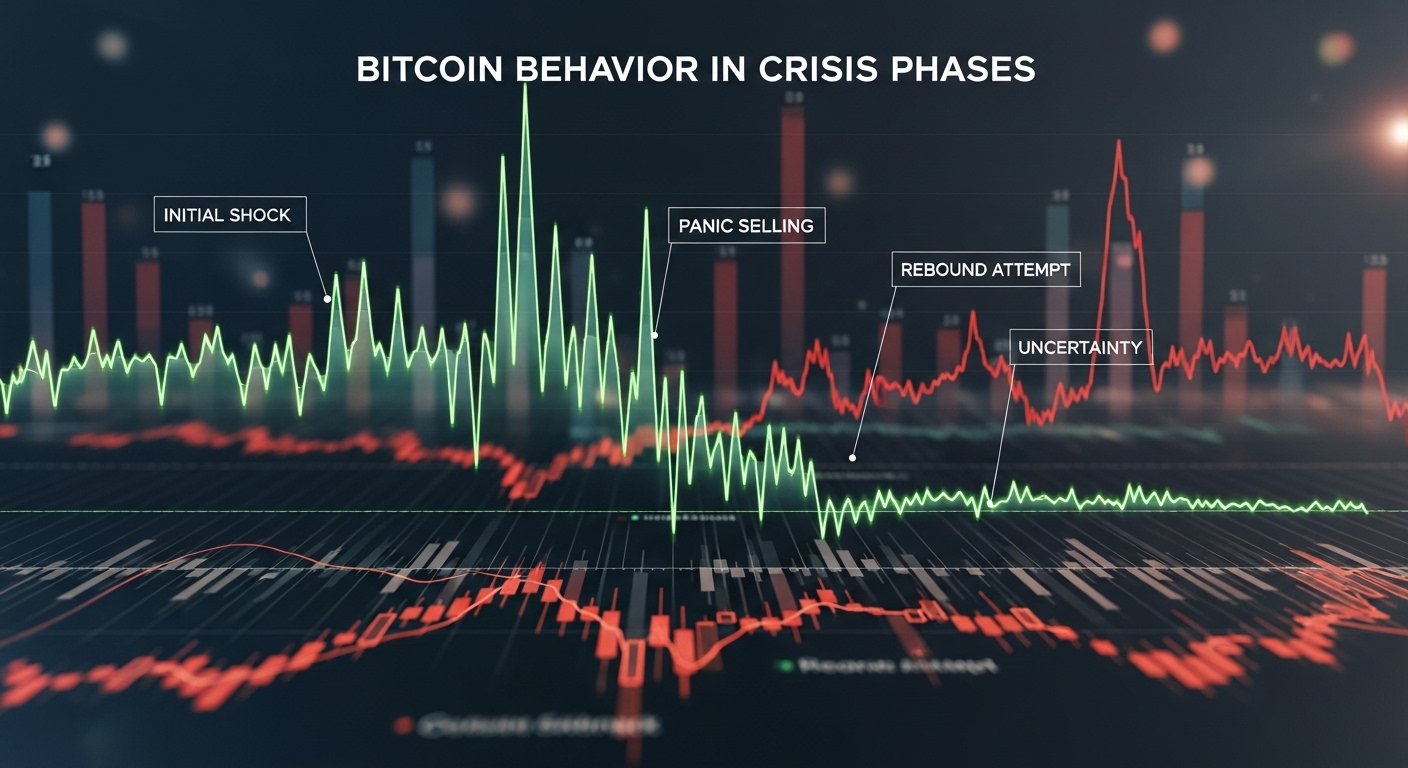
To trade or invest intelligently around a geopolitical thesis, you have to understand crisis sequencing. The market often moves in stages.
Phase One—Risk-Off Liquidity Grab
When uncertainty spikes, investors often sell volatile assets to raise cash. Bitcoin can drop sharply in this phase, even if the longer-term narrative is bullish. This is not a contradiction; it’s a liquidity event. People sell what they can, not what they want.
Phase Two—Policy Anticipation
As markets digest the shock, attention shifts from “What happened?” to “What will policymakers do?” If expectations move toward rate cuts, liquidity support, or broader easing, Bitcoin can begin to recover and sometimes rally aggressively.
Phase Three—Liquidity Confirmation
If easing actually arrives—through cuts, softer guidance, or financial conditions that improve—Bitcoin often benefits from renewed risk appetite. This is the phase Hayes is aiming at when he says an Iran conflict could trigger Fed easing and boost Bitcoin.
Market Mechanics: Why Fed Easing Can Lift Bitcoin So Fast
The phrase Arthur Hayes says Iran conflict could trigger Fed easing, boost Bitcoin also reflects how quickly Bitcoin can reprice compared to other assets.
Bitcoin Trades Expectations, Not Headlines
Because Bitcoin is global and trades continuously, it reacts quickly to shifts in macro expectations. If traders begin to price a more accommodative Fed stance, Bitcoin can rally even before traditional markets fully adjust.
Lower Real Yields Reduce the Opportunity Cost
Bitcoin doesn’t pay interest. When real yields fall, holding Bitcoin becomes comparatively more attractive. If conflict risk pushes growth down and increases the probability of easing, real yields can compress. That environment tends to support Bitcoin’s valuation narrative as digital gold and a scarce asset.
Dollar Weakness Can Help Crypto
Easing expectations can also weaken the dollar, depending on global conditions. A softer dollar often improves the appeal of global risk assets and can increase capital flows into crypto markets.
What Could Invalidate the Thesis?
No macro thesis is complete without a clear look at what can go wrong. The fact that an idea sounds plausible doesn’t mean it will play out on your timeline.
Conflict De-Escalates Quickly
If tensions fade and markets regain confidence, the easing probability can drop. In that case, the “conflict-driven catalyst” weakens, and Bitcoin returns to trading on other factors like adoption, risk appetite, and the broader economic cycle.
Inflation Stays Hot Enough to Delay Easing
If energy prices rise and inflation proves sticky, the Fed may keep policy restrictive. That can cap or delay Bitcoin upside, especially if real yields remain high. The market may still rally on longer-term scarcity narratives, but the immediate “Fed easing” tailwind becomes less reliable.
A Broader Risk Event Triggers Forced Selling
In a major systemic shock, Bitcoin can be sold alongside equities as investors reduce leverage. Even if easing eventually arrives, the drawdown before the pivot can be severe. This is why sizing, risk management, and patience matter when dealing with conflict-driven narratives.
How to Track the “Fed Easing” Setup Without Chasing Noise
If you’re evaluating the thesis that Arthur Hayes says Iran conflict could trigger Fed easing, boost Bitcoin, focus on signals that translate geopolitics into policy expectations.
Watch Easing Expectations in Market Pricing
Markets often price future rate paths before the Fed changes policy. When the expected path shifts toward cuts, Bitcoin can respond quickly. The key is not what commentators think should happen, but what markets begin to price as most likely.
Track Financial Conditions and Credit Stress
If credit spreads widen, lending tightens, and risk assets struggle to finance themselves, pressure for stabilization increases. Conflict can accelerate that stress, especially if uncertainty persists.
Follow the Tone of Central Bank Communication
Even without immediate cuts, a shift in tone matters. Language that emphasizes downside risks, financial stability, or the need to remain “data dependent” can signal openness to easing if conditions deteriorate.
Putting It All Together: Scenarios for Bitcoin
The narrative behind Arthur Hayes says Iran conflict could trigger Fed easing, boost Bitcoin becomes clearer when you think in scenarios rather than certainties.
Scenario One—Short Shock, Quick Normalization
If the conflict does not expand and markets stabilize, the easing narrative loses power. Bitcoin may still perform, but for reasons unrelated to geopolitical policy shifts.
Scenario Two—Prolonged Stress, Easing Becomes the Base Case
If uncertainty persists, growth slows, and financial conditions tighten, the probability of easing rises. Bitcoin may experience turbulence early, then potentially rally as markets begin to anticipate a liquidity-friendly turn.
Scenario Three—Inflation Shock Overrides Everything
If inflation re-accelerates and remains sticky, easing may be delayed. Bitcoin might still be volatile and could rally on scarcity narratives, but the “Fed easing” catalyst becomes weaker until economic conditions force a pivot.
Conclusion
The reason this story is spreading is not because conflict automatically makes Bitcoin rise. It’s because the market is always trying to front-run the policy response. When Arthur Hayes argues that an Iran conflict could trigger Fed easing and boost Bitcoin, he’s not describing a guaranteed outcome. He’s describing a probability shift: the odds of a liquidity-friendly environment rise if the conflict creates sustained economic and financial pressure.
Bitcoin can fall first in a risk-off scramble. It can chop sideways while markets debate inflation versus growth. And it can surge when the crowd becomes confident that easier conditions are coming. If you want to use this framework, focus on the plumbing: expectations, yields, dollar liquidity, and financial conditions. That’s where the thesis lives. In that sense, the headline Arthur Hayes says Iran conflict could trigger Fed easing, boost Bitcoin is best treated as a roadmap to what to watch—not a promise of what must happen.
