


Crypto markets rarely move in straight lines, and when they do, they never do so quietly. Over the past several weeks, traders expecting a textbook altcoin season have instead watched meme coins explode upward, with some posting gains of more than 140% in a short period. Meanwhile, many established altcoins have struggled to keep pace. This contrast has sparked an increasingly popular question across the crypto community: is altcoin season delayed, or is this meme coin rally actually the first signal of a broader market rotation?
At first glance, meme coin surges can feel disconnected from logic. Tokens with little fundamental utility suddenly dominate volume charts and social media feeds, while technically stronger projects remain comparatively muted. Yet history suggests that speculative rallies often carry deeper meaning. Meme coins tend to thrive when risk appetite returns, liquidity improves, and traders are willing to chase momentum again. That behavior, while chaotic, can be an early indicator that capital is preparing to rotate into the wider altcoin market.
Still, the situation is far from straightforward. Bitcoin dominance remains elevated, large-cap altcoins have yet to decisively outperform, and market breadth is uneven. These mixed signals explain why “altcoin season delayed” has become such a persistent narrative. This article explores what the 140% meme coin rally really means, how capital rotation works in modern crypto markets, and whether this phase represents a delay—or a different pathway—toward the next true altcoin season.
Altcoin Season Delayed
The idea of altcoin season traditionally refers to a period when a majority of altcoins significantly outperform Bitcoin over a sustained timeframe. In past cycles, this usually followed a clear pattern: Bitcoin rallied first, then consolidated, capital rotated into Ethereum and large-cap altcoins, and finally mid- and small-cap altcoins surged in unison. When that expected sequence doesn’t materialize, frustration builds. Investors begin to question whether the cycle is broken or simply running on a different schedule. The phrase altcoin season delayed captures that tension. It reflects a market where enthusiasm exists, but confirmation remains elusive.
In the current environment, several factors contribute to this feeling. Bitcoin continues to command a large share of total crypto market capitalization. Ethereum’s relative performance has improved at times but has not yet sustained a clear breakout against Bitcoin. At the same time, meme coins have absorbed a disproportionate amount of speculative capital. Together, these dynamics suggest that while the conditions for altcoin season may be forming, the transition is incomplete.
The 140% Meme Coin Rally as a Market Signal
A meme coin rally of 140% or more is not just noise. It is a powerful expression of market psychology. Meme coins sit at the far end of the risk spectrum, meaning they tend to outperform only when traders feel confident enough to embrace volatility. When fear dominates, these assets are usually the first to be abandoned.
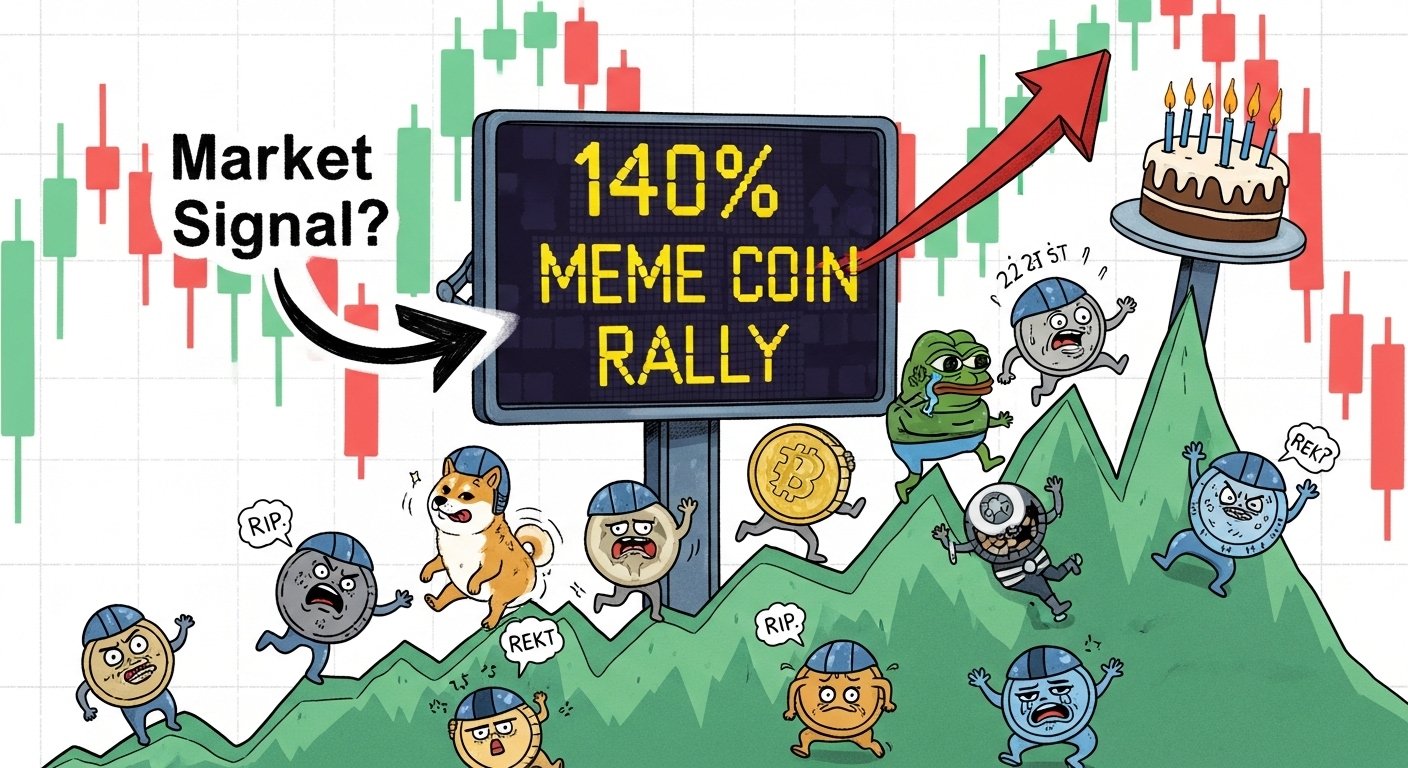
The recent meme coin surge indicates that speculative energy has returned to the market. Trading volumes have increased, social engagement has intensified, and short-term momentum strategies are back in play. These are not characteristics of a market in survival mode; they are signs of renewed liquidity and willingness to take risk.
However, speculative energy does not automatically translate into sustainable growth. Meme coins often move faster than the broader market because they rely heavily on attention and momentum rather than long-term conviction. This makes them excellent early indicators—but unreliable long-term leaders. Their role is often to ignite interest rather than to carry the market through an entire cycle.
Why Meme Coins Often Lead Early Market Rotations
In crypto, capital tends to rotate through assets based on perceived opportunity and relative risk. When conditions shift from defensive to opportunistic, traders frequently start at the most speculative end of the spectrum. Meme coins, with their low barriers to entry and explosive upside potential, fit this role perfectly.
This behavior explains why meme coins often rally before more established altcoins. They act as a pressure valve for pent-up speculation. Once early traders realize gains, that capital rarely exits the market entirely. Instead, it searches for the next opportunity, typically moving toward assets with deeper liquidity and stronger narratives. From this perspective, a meme coin rally can be interpreted as the opening stage of a broader market rotation. The key question is whether that rotation continues into major altcoins or stalls within speculative corners.
Bitcoin Dominance and Its Role in Delaying Altcoin Season
One of the most important metrics for understanding altcoin season delayed is Bitcoin dominance. This measure reflects Bitcoin’s share of the total crypto market capitalization and serves as a proxy for where capital is concentrated. When Bitcoin dominance rises, it indicates that investors prefer safety and liquidity. When it falls, capital is dispersing into altcoins. In a healthy altcoin season, Bitcoin dominance typically trends downward for an extended period.
Currently, Bitcoin dominance has remained relatively resilient. While it has experienced short-term pullbacks, it has not yet entered a sustained decline. This persistence suggests that many investors are still anchoring their portfolios around Bitcoin, even as they experiment with speculative trades in meme coins. As long as dominance remains elevated, broad altcoin outperformance may continue to feel delayed.
Ethereum’s Position as the Gateway Asset
Ethereum has historically acted as the bridge between Bitcoin-led markets and full-scale altcoin seasons. Its performance relative to Bitcoin often sets the tone for the rest of the altcoin market. When Ethereum consistently outperforms Bitcoin, confidence tends to spill over into other smart contract platforms, DeFi tokens, and ecosystem projects.
In the current cycle, Ethereum’s progress has been uneven. Periods of strength have been followed by consolidation, leaving traders uncertain about whether a sustained rotation is underway. This uncertainty reinforces the perception of altcoin season delayed, even as meme coins surge ahead. For many investors, a decisive and prolonged Ethereum breakout remains a critical confirmation signal. Without it, meme-driven rallies can feel isolated rather than transformational.
Liquidity Flows and the Competition Between Memes and Altcoins
One reason meme coin rallies can delay broader altcoin momentum is simple: liquidity is finite. When speculative capital floods into meme coins, it is capital that is not simultaneously supporting large-cap or mid-cap altcoins. This competition for liquidity can create a temporary imbalance. Meme coins dominate headlines and trading volumes, while fundamentally stronger projects struggle to attract attention.
Over time, this can frustrate long-term holders and reinforce the narrative that altcoin season has been postponed. However, this imbalance is often temporary. If meme coin traders begin taking profits and reallocating into higher-quality assets, liquidity can rapidly shift. The speed of this transition is one of the defining characteristics of modern crypto markets.
Market Breadth and Why It Matters More Than Headlines
True altcoin seasons are defined by breadth, not just by a few standout performers. When dozens of altcoins across multiple sectors outperform Bitcoin simultaneously, it indicates a structural change in market behavior. In contrast, meme coin rallies are typically narrow. A handful of tokens may post extraordinary gains, but the majority of altcoins remain range-bound.
This lack of breadth is a key reason why analysts continue to describe the current phase as altcoin season delayed rather than fully underway. Breadth expansion often unfolds gradually. It begins with isolated rallies, then spreads to sector leaders, and finally encompasses a wide array of mid- and small-cap assets. The meme coin rally may represent the first step of this process rather than its conclusion.
The Role of Narratives in a Fragmented Market
Crypto markets are increasingly driven by narratives. Meme coins thrive on humor, identity, and viral momentum. Other sectors depend on themes like scalability, artificial intelligence, gaming, or decentralized finance. In recent cycles, these narratives can rise and fall quickly, leading to what many traders describe as “mini altcoin seasons” rather than a single, prolonged event.
This narrative fragmentation can make altcoin season delayed feel more confusing than in the past. Instead of one broad wave, the market may experience a series of overlapping rotations. Meme coins may dominate first, followed by infrastructure tokens, then niche sectors—all without a clear, unified breakout. Understanding this shift is essential. The absence of a traditional altcoin season does not necessarily imply weakness; it may reflect a more complex and faster-moving ecosystem.
Risks Associated With Meme-Led Market Phases
While meme coin rallies can be exciting, they also carry risks. Rapid price increases often attract leverage, increasing the likelihood of sharp corrections. When these corrections occur, they can temporarily dampen overall market sentiment, reducing risk appetite across the board. If meme coins collapse without a corresponding rotation into larger altcoins, the result can be a choppy market that feels directionless. In such scenarios, altcoin season delayed can become self-reinforcing, as traders grow cautious and liquidity retreats. This is why many experienced investors watch not just price action, but also how the market responds to pullbacks. Healthy rotations tend to absorb volatility and continue building. Fragile rallies tend to unwind quickly.
What Would Confirm That Altcoin Season Is No Longer Delayed?
For the narrative to shift decisively away from altcoin season delayed, several conditions usually need to align. Bitcoin dominance would need to trend lower over an extended period. Ethereum would need to demonstrate sustained relative strength. Market breadth would need to expand, with multiple sectors outperforming simultaneously.

Equally important is sentiment stability. Instead of rapid rotations driven purely by hype, investors would begin holding positions longer and allocating capital more strategically. When these behaviors emerge together, the market transitions from speculation-driven rallies to a more durable altcoin season.
Long-Term Perspective: Delay Does Not Mean Denial
It is important to distinguish between delay and disappearance. An altcoin season delayed is not an altcoin season canceled. Markets evolve, cycles stretch, and structures change. What feels like delay may simply be consolidation before expansion. The meme coin rally suggests that the market’s speculative engine is running again. Whether that energy translates into sustained altcoin leadership remains to be seen, but history suggests that speculation often precedes broader participation.
Conclusion
The 140% meme coin rally has reignited debate across the crypto landscape. To some, it looks like reckless speculation stealing oxygen from legitimate projects. To others, it appears to be the first spark of a long-awaited rotation. Both interpretations carry truth. The reality is that altcoin season delayed remains an accurate description of the broader market, even as pockets of explosive growth emerge. Meme coins are signaling renewed risk appetite and liquidity, but confirmation of a full altcoin season will require stronger breadth, sustained large-cap performance, and a decisive shift in Bitcoin dominance. If those conditions materialize, today’s meme coin rally may be remembered not as a distraction, but as the opening move in the next major altcoin cycle.
FAQs
Q: Does a meme coin rally mean altcoin season has started?
Not necessarily. Meme coin rallies show increased risk appetite, but altcoin season typically requires broad and sustained outperformance across many altcoins, not just a few speculative tokens.
Q: Why is altcoin season considered delayed right now?
Altcoin season is considered delayed because Bitcoin dominance remains high, Ethereum has not consistently outperformed Bitcoin, and market breadth across altcoins is still limited.
Q: Can meme coins delay altcoin season?
Yes. Meme coins can absorb speculative liquidity that might otherwise flow into larger altcoins, temporarily delaying broader market participation.
Q: What signals should I watch for a real altcoin season?
Key signals include declining Bitcoin dominance, sustained strength in Ethereum, expanding market breadth, and rotation into multiple altcoin sectors beyond memes.
Q: Is a delayed altcoin season a bad sign for crypto?
Not at all. A delay often reflects consolidation and structural change. Many strong altcoin seasons have followed periods of uncertainty and uneven market behavior.
