


Bitcoin and traditional financial markets once again moved in sync as global investors reacted sharply to newly released Federal Reserve meeting minutes. As concerns resurfaced about a possible interest rate hike, Bitcoin sinks to $66,000, breaking lower after days of fragile consolidation. At the same time, U.S. stocks lose steam, with major indexes giving up earlier gains as investors reassessed the outlook for monetary policy, inflation, and economic growth.
The reaction highlights a growing reality in modern markets: Bitcoin is no longer trading purely as an alternative asset detached from macroeconomics. Instead, it behaves increasingly like a high-risk, liquidity-sensitive instrument that responds immediately to shifts in interest rate expectations. When the Fed signals caution—or even hints at tighter policy—Bitcoin and equities often feel the impact simultaneously.
The Fed minutes suggested that inflation risks remain present and that policymakers are not ruling out additional tightening if price pressures fail to ease further. Even without a direct commitment to raising rates, this language was enough to unsettle markets. Investors, already sensitive to policy uncertainty, quickly reduced exposure to risk assets. This shift in sentiment explains why Bitcoin sinks to $66,000 while U.S. stocks struggle to maintain momentum.
Market reaction to the Fed minutes
Federal Reserve minutes are closely analyzed because they provide insight into policymakers’ internal debates rather than just their final decisions. In this case, the minutes emphasized caution, patience, and a willingness to respond forcefully if inflation stalls above the Fed’s target.
Why “possible rate hike” language matters so much
Markets are driven by expectations, not just actions. The mere mention of a possible rate hike changes how traders price future outcomes. Even if rates remain unchanged, the acknowledgment that hikes are still on the table increases uncertainty. That uncertainty raises borrowing costs, strengthens the U.S. dollar, and reduces liquidity across financial markets.
For Bitcoin, which thrives in environments of easy money and expanding liquidity, this shift can be especially damaging. When investors anticipate tighter conditions, they often move capital into safer, yield-bearing assets. As a result, Bitcoin sinks to $66,000 as speculative demand weakens.
Two-sided risk reshapes investor behavior
The Fed’s discussion of two-sided risks—meaning rates could move up or down depending on inflation—removed the sense of predictability that markets crave. When investors no longer feel confident about the direction of policy, they tend to reduce leverage and exposure. This deleveraging process can accelerate declines in volatile assets like Bitcoin.
Why Bitcoin sinks to $66,000 amid tightening expectations
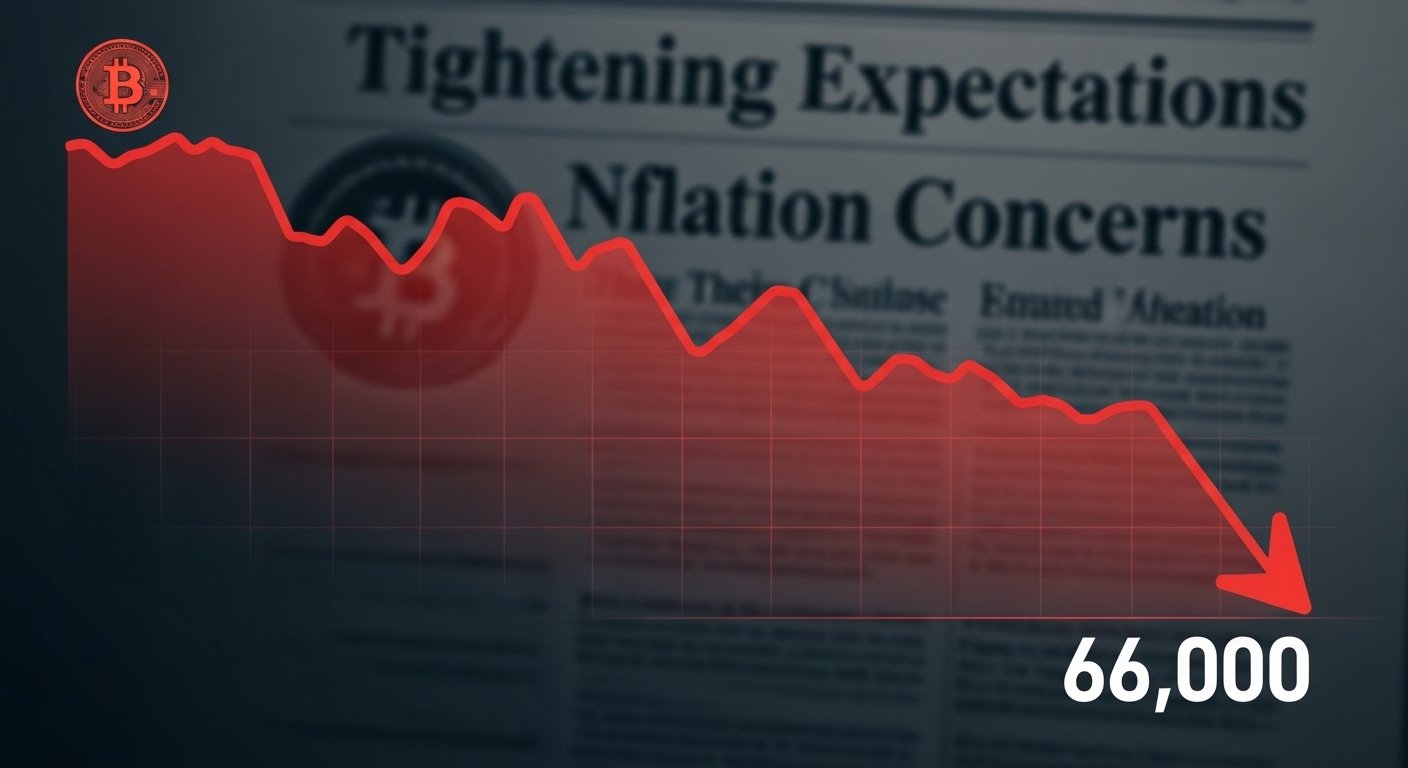
The drop to $66,000 was not accidental. It reflects a combination of technical pressure, macroeconomic repricing, and changes in investor psychology. Bitcoin had been trading within a narrow range, supported by optimism around long-term adoption and institutional interest. However, the renewed focus on interest rate risk disrupted that balance. As soon as rate hike concerns resurfaced, sellers gained control.
Interest rates, liquidity, and Bitcoin’s sensitivity
Bitcoin is highly sensitive to interest rates because it does not generate yield. When interest rates rise or are expected to rise, holding cash or bonds becomes more attractive. This dynamic reduces demand for non-yielding assets and pushes Bitcoin lower. Liquidity also plays a critical role. Tighter monetary policy reduces the amount of capital flowing through financial systems. Less liquidity means fewer buyers willing to absorb selling pressure, making declines sharper and faster. This is a key reason why Bitcoin sinks to $66,000 during periods of hawkish Fed sentiment.
Psychological levels amplify price movement
Round numbers such as $66,000 carry psychological importance. Traders often place stop-loss orders and bids around these levels, increasing volatility when price approaches them. Once Bitcoin fell toward $66,000, momentum traders stepped in, accelerating the move and reinforcing bearish sentiment.
U.S. stocks lose steam as risk appetite fades
While Bitcoin experienced a sharper move, U.S. equities also reacted negatively. Major stock indexes initially showed strength but lost momentum as the implications of the Fed minutes sank in. This pattern—early optimism followed by caution—is typical when monetary policy uncertainty rises.
Growth stocks and rate sensitivity
High-growth stocks are particularly vulnerable to interest rate expectations. Their valuations depend heavily on future earnings, which are discounted more aggressively when rates rise. As a result, even a small shift in rate outlook can lead to selling pressure. When U.S. stocks lose steam, it often signals broader risk aversion. This environment tends to spill over into crypto markets, reinforcing downside pressure on Bitcoin.
Narrow leadership increases fragility
Recent equity gains have been concentrated in a small group of large-cap stocks. When market leadership is narrow, overall market stability weakens. Any negative macro signal—such as the possibility of a rate hike—can quickly undermine confidence and trigger widespread selling.
Inflation remains the central issue
At the heart of the market reaction is inflation. While inflation has eased from previous highs, it has not fallen quickly enough to reassure policymakers. Persistent price pressures force the Fed to maintain a cautious stance, even if economic growth shows signs of slowing.
Sticky inflation and policy uncertainty
Sticky inflation creates a dilemma. Cutting rates too soon risks reigniting price pressures, while holding rates too high risks slowing the economy. This tension was evident in the Fed minutes and explains why investors reacted so strongly. For Bitcoin, inflation uncertainty cuts both ways. While some view Bitcoin as an inflation hedge, in practice it behaves more like a risk asset during periods of monetary tightening. That contradiction helps explain why Bitcoin sinks to $66,000 despite ongoing inflation concerns.
The dollar and bond yields add pressure
Rising interest rate expectations tend to strengthen the U.S. dollar and push bond yields higher. Both developments are typically negative for Bitcoin. A stronger dollar makes Bitcoin more expensive for international investors, reducing global demand. Higher bond yields offer safer returns, drawing capital away from speculative investments. Together, these forces create a challenging environment for crypto markets.
What investors should watch next

The direction of Bitcoin and U.S. stocks will depend largely on upcoming economic data and future Fed communication. Inflation reports, employment figures, and consumer spending data all influence expectations for monetary policy.
Fed communication remains critical
Markets are highly sensitive to tone. Even subtle changes in language can trigger significant price movements. If future Fed statements emphasize progress on inflation, risk assets could stabilize. If caution dominates, volatility may increase further.
Liquidity indicators and market sentiment
Beyond official data, investors should watch liquidity conditions, credit markets, and overall risk sentiment. Bitcoin often moves ahead of traditional markets, making it a useful barometer for broader financial stress.
Long-term perspective on Bitcoin’s pullback
While the headline that Bitcoin sinks to $66,000 may sound alarming, it does not necessarily signal the end of the broader crypto trend. Bitcoin has historically experienced sharp pullbacks even during long-term uptrends. Short-term price action is dominated by macro forces, but long-term value is influenced by adoption, network growth, and market structure. Investors who understand this distinction are better equipped to navigate volatility.
Conclusion
Bitcoin sinks to $66,000 as markets digest the implications of Federal Reserve minutes that revived concerns about a possible rate hike. At the same time, U.S. stocks lose steam, reflecting a broader shift toward caution as investors reassess inflation risks and monetary policy direction.
The reaction underscores Bitcoin’s growing connection to traditional financial markets and its sensitivity to liquidity conditions. While short-term volatility may persist, the long-term outlook will depend on how inflation evolves and how the Fed responds. For now, the message from markets is clear: uncertainty around interest rates remains a powerful force shaping asset prices.
FAQs
Q: Why did Bitcoin sinks to $66,000 after the Fed minutes?
Bitcoin fell because the Fed minutes suggested that interest rate hikes are still possible if inflation remains elevated. This raised concerns about tighter liquidity, which typically pressures risk assets like Bitcoin.
Q: Is Bitcoin negatively affected by higher interest rates?
In the short term, yes. Higher interest rates reduce liquidity and make yield-bearing assets more attractive, which can weaken demand for Bitcoin.
Q: Why do U.S. stocks lose steam when rate hike fears emerge?
Stocks, especially growth stocks, are sensitive to interest rates. Higher rates increase borrowing costs and reduce the present value of future earnings, leading to reduced investor appetite.
Q: Is $66,000 an important level for Bitcoin?
Yes. It is a psychological and technical level where buying and selling pressure often increases, making it a key area to watch for market direction.
Q: What could help Bitcoin recover from this drop?
Cooling inflation data, clearer signals of rate cuts, improving liquidity conditions, or strong crypto-specific developments could all help support a rebound in Bitcoin prices.
See More: Bitcoin ETF Liquidation Risk Explained The Hidden Truth
